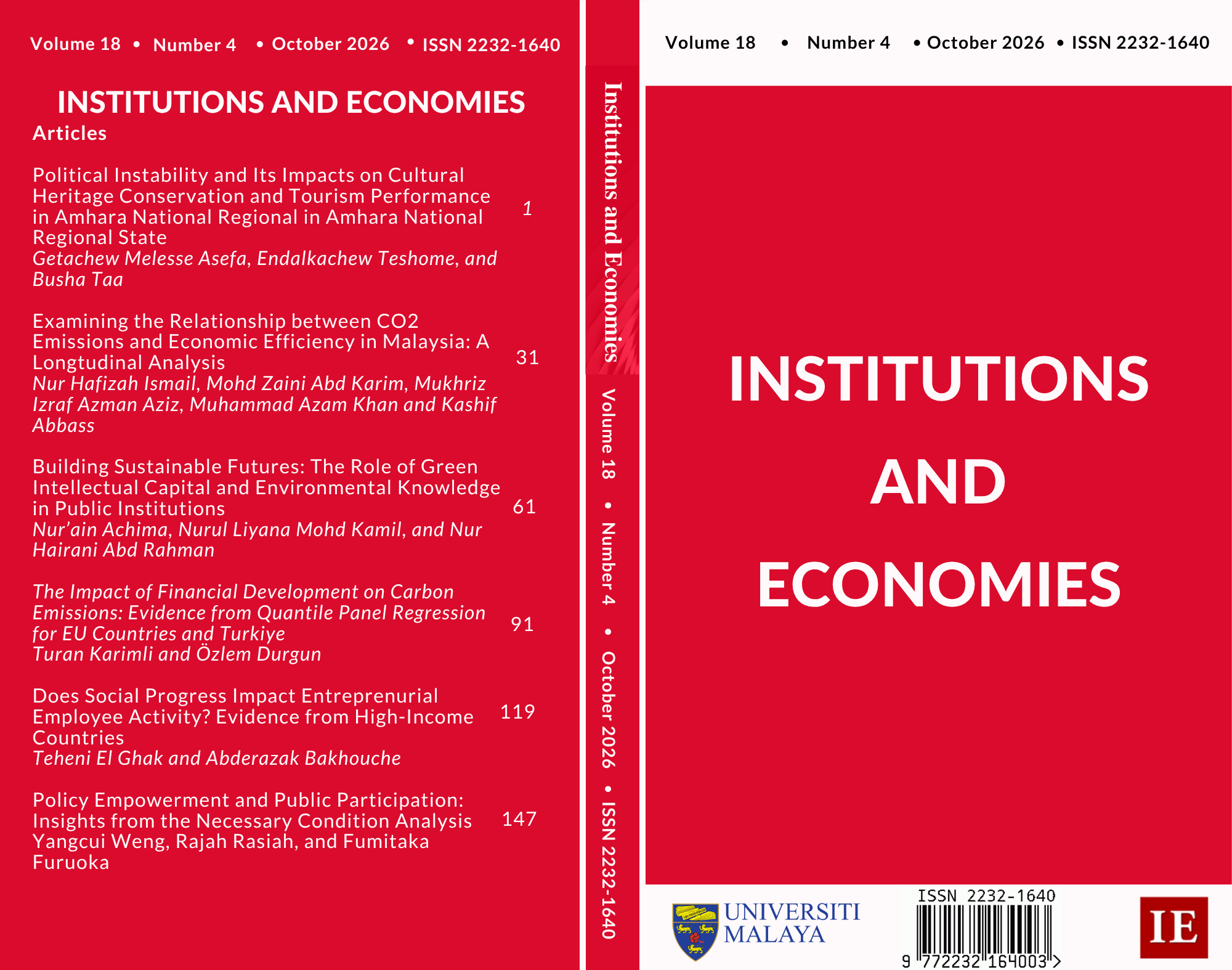
The Impact of Financial Development on Carbon Emissions: Evidence from Quantile Panel Regression for EU Countries and Türkiye
DOI:
https://doi.org/10.22452/IJIE.vol18no4.4Keywords:
Climate change, Financial development, Carbon emission, Environmental Kuznets curve, Panel quantile distributionAbstract
This study examines the dynamic impact of financial development on
carbon emissions in European Union nations and Türkiye from 2010 to 2023. The
research utilises panel quantile regression methods to tackle the intrinsic variability
in the link between financial development and environmental consequences, offering
a more thorough insight than conventional mean-based econometric techniques. The
analytical approach facilitates the examination of unique repercussions at various levels
of carbon emissions, revealing insights into the distinct effects of financial mechanisms
in different environmental circumstances. The findings offer empirical evidence for an
N-shaped Environmental Kuznets Curve, indicating a non-linear correlation between
economic development and environmental quality. This research significantly enhances
the literature by including financial development into the discourse on environmental
policy. It underscores the necessity of tailoring financial policies to achieve sustainable
development goals. The findings offer critical policy implications, emphasising the role of
targeted financial interventions in mitigating environmental harm and aligning economic
activities with sustainability objectives. The findings have crucial policy implications,
stressing the need for targeted financial measures in minimising environmental impact.
To boost empirical credibility, robustness checks utilising Driscoll-Kraay standard errors
were undertaken, verifying the consistency of the results across estimation methodologies.
Downloads
Published
Issue
Section
License
Submission of a manuscript implies: that the work described is original, has not been published before (except in the form of an abstract or as part of a published lecture, review, or thesis); that is not under consideration for publication elsewhere; that its publication has been approved by all co-authors, if any, as well as tacitly or explicitly by the responsible authorities at the institution where the work was carried out. Transfer of copyright to the University of Malaya becomes effective if and when the article is accepted for publication. The copyright covers the exclusive right to reproduce and distribute the article, including reprints, translations, photographic reproductions, microform, electronic form (offline and online) or other reproductions of similar nature.
An author may self-archive the English language version of his/her article on his/her own website and his/her institutions repository; however he/she may not use the publishers PDF version which is posted on www.ijie.um.edu.my. Furthermore, the author may only post his/her version, provided acknowledgement is given to the original source of publication and a link must be accompanied by the following text: The original publication is available at www.ijie.um.edu.my.
All articles published in this journal are protected by copyright, which covers the exclusive rights to reproduce and redistribute the article (e.g. as offprint), as well as all translation rights. No material published in this journal may be reproduced photographically or stored on microfilm, in electronic database, video disks, etc., without first obtaining written permission from the publishers. The use of general descriptive names, trade names, trademarks, etc., in this publication, even if not specifically identified, does not imply that these names are not protected by the relevant laws and regulations.
The copyright owners consent does not include copying for general distribution, promotion, new works, or resale. In these cases, specific written permission must first be obtained from the publishers.