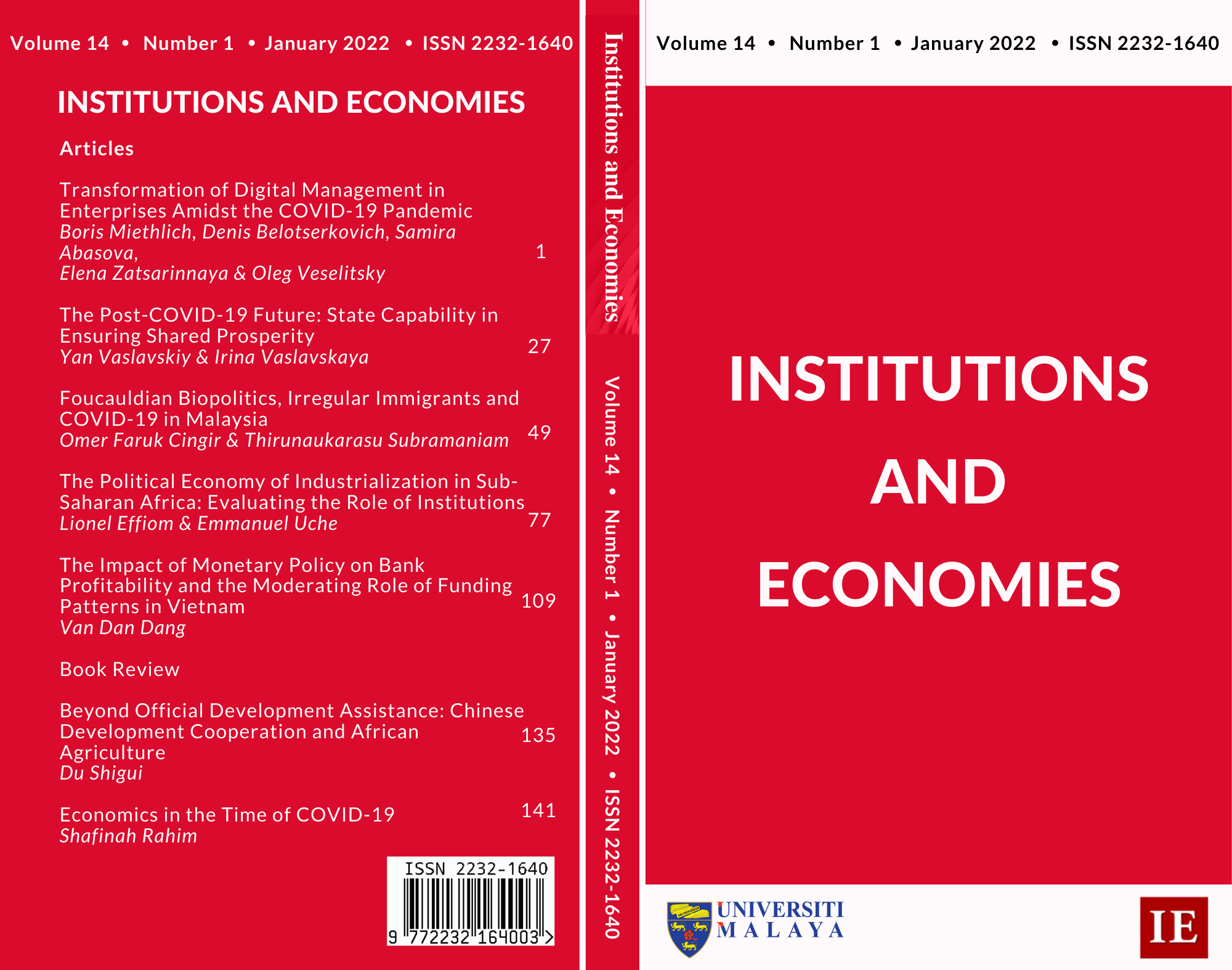
The Post-COVID-19 Future: State Capability in Ensuring Shared Prosperity
DOI:
https://doi.org/10.22452/IJIE.vol14no1.2Keywords:
Social fault lines, Triangle dilemma of Musgrave, Societal crisis, State inefficiency, Epinomic policyAbstract
The coronavirus (COVID-19) pandemic has caused profound upheavals in national communities, from humanitarian disasters to unprecedented economic downturns. All the consequences of COVID-19 have made it necessary to understand the reasons for state inefficiency and its traditional functions of ensuring economic balance and financial stability in the period before COVID-19. In fact, inefficiency is a fundamental problem of modern socioeconomic systems. Only a violation of societal integrity can explain why economic isolation and social distancing managed to instantly destroy economic structures, cause a loss in confidence in governments by citizens and increase the potential for protest against the extraordinary actions of nation-states in the fight against COVID-19. At the end of 2020, there was universal agreement about a fundamentally uncertain post-COVID-19 reality. Many progressive specialists have expressed the opinion that the degree of future socioeconomic progress directly depends on the abilities of policymakers to prioritise societal integrity in solving economic problems and achieving the goal of shared prosperity in the future.
Downloads
Published
Issue
Section
License
Submission of a manuscript implies: that the work described is original, has not been published before (except in the form of an abstract or as part of a published lecture, review, or thesis); that is not under consideration for publication elsewhere; that its publication has been approved by all co-authors, if any, as well as tacitly or explicitly by the responsible authorities at the institution where the work was carried out. Transfer of copyright to the University of Malaya becomes effective if and when the article is accepted for publication. The copyright covers the exclusive right to reproduce and distribute the article, including reprints, translations, photographic reproductions, microform, electronic form (offline and online) or other reproductions of similar nature.
An author may self-archive the English language version of his/her article on his/her own website and his/her institutions repository; however he/she may not use the publishers PDF version which is posted on www.ijie.um.edu.my. Furthermore, the author may only post his/her version, provided acknowledgement is given to the original source of publication and a link must be accompanied by the following text: The original publication is available at www.ijie.um.edu.my.
All articles published in this journal are protected by copyright, which covers the exclusive rights to reproduce and redistribute the article (e.g. as offprint), as well as all translation rights. No material published in this journal may be reproduced photographically or stored on microfilm, in electronic database, video disks, etc., without first obtaining written permission from the publishers. The use of general descriptive names, trade names, trademarks, etc., in this publication, even if not specifically identified, does not imply that these names are not protected by the relevant laws and regulations.
The copyright owners consent does not include copying for general distribution, promotion, new works, or resale. In these cases, specific written permission must first be obtained from the publishers.