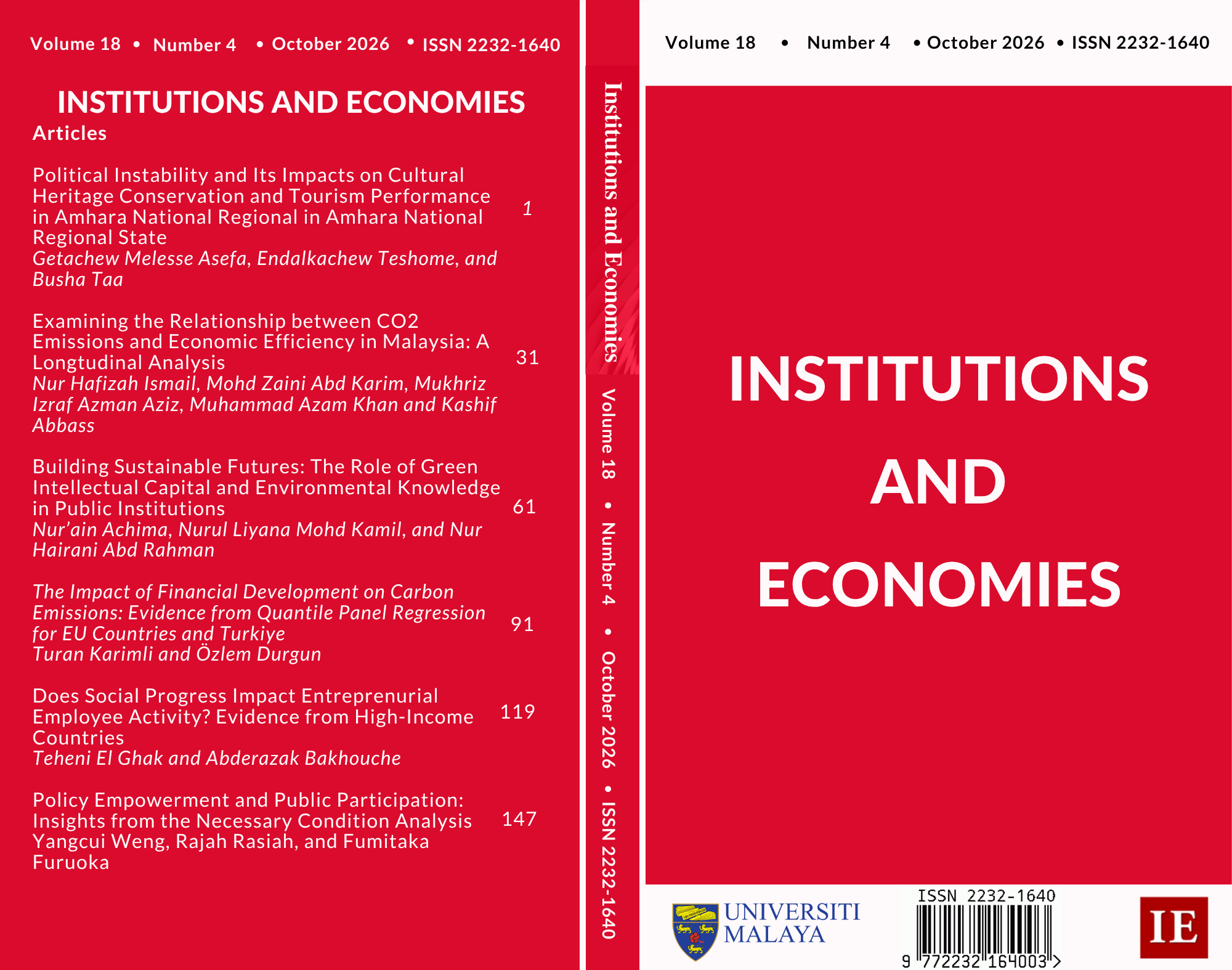
Does Social Progress Impact Entrepreneurial Employee Activity? Evidence from High-Income Countries
DOI:
https://doi.org/10.22452/IJIE.vol18no4.5Keywords:
Entrepreneurial employee activity, High-income countries, Intrapreneurship, Panel data, Social progressAbstract
In recent years, the global economy has experienced a significant rise in
trade and financial globalisation, driven by deregulation, ICT advancements, increased
competition, and various business and financial risks. In parallel, social progress has
added complexity to the business environment and highlighted the importance of other
types of risks, such as social risk. Aware of this risk-diffusing development, many
businesses have devised strategies that consider the entrepreneurial attributes of their
employees, commonly referred to as entrepreneurial employee activity (EEA), as a vital
factor for creating value. This study examines how social progress and its components
facilitate EEA, using a dataset from 26 advanced countries during 2014–2019.
Estimation results from a static panel model reveal a significant impact of social progress
on EEA. Basic Human Needs and Opportunity play more substantial roles in influencing
EEA, whereas the impact of Well-being is more marginal. The research underscores the
importance of formulating and implementing social progress-based policies to promote
EEA. Policies should prioritise securing basic needs and expanding access to individual
opportunities through education, training, and supportive institutional frameworks.
Employee profit-sharing schemes, intellectual property protection for intrapreneurs,
tax incentives for firms offering upskilling programmes, and protections that reduce job
insecurity could foster EEA.
Downloads
Published
Issue
Section
License
Submission of a manuscript implies: that the work described is original, has not been published before (except in the form of an abstract or as part of a published lecture, review, or thesis); that is not under consideration for publication elsewhere; that its publication has been approved by all co-authors, if any, as well as tacitly or explicitly by the responsible authorities at the institution where the work was carried out. Transfer of copyright to the University of Malaya becomes effective if and when the article is accepted for publication. The copyright covers the exclusive right to reproduce and distribute the article, including reprints, translations, photographic reproductions, microform, electronic form (offline and online) or other reproductions of similar nature.
An author may self-archive the English language version of his/her article on his/her own website and his/her institutions repository; however he/she may not use the publishers PDF version which is posted on www.ijie.um.edu.my. Furthermore, the author may only post his/her version, provided acknowledgement is given to the original source of publication and a link must be accompanied by the following text: The original publication is available at www.ijie.um.edu.my.
All articles published in this journal are protected by copyright, which covers the exclusive rights to reproduce and redistribute the article (e.g. as offprint), as well as all translation rights. No material published in this journal may be reproduced photographically or stored on microfilm, in electronic database, video disks, etc., without first obtaining written permission from the publishers. The use of general descriptive names, trade names, trademarks, etc., in this publication, even if not specifically identified, does not imply that these names are not protected by the relevant laws and regulations.
The copyright owners consent does not include copying for general distribution, promotion, new works, or resale. In these cases, specific written permission must first be obtained from the publishers.