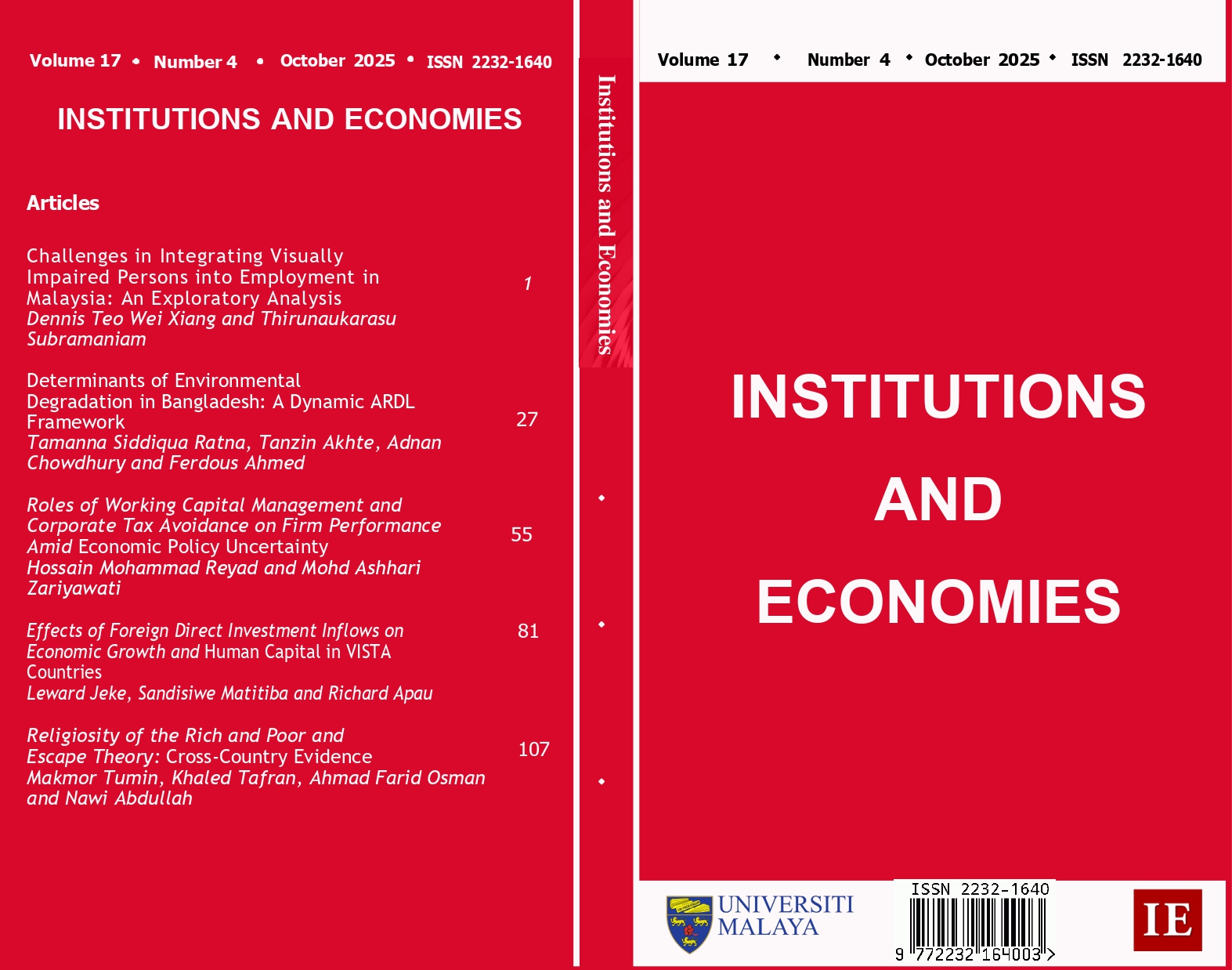
Religiosity of the Rich and Poor and Escape Theory: Cross-Country Evidence
DOI:
https://doi.org/10.22452/IJIE.vol17no4.5Keywords:
Atheism, Escape theory, Religiosity, Poor countries, Rich countriesAbstract
This study attempts to explore the relevance of secularisation theory and
its relationship with escape theory, by examining the probable quadratic nature of
the relationship between income and religiosity beyond individual data. This research
reveals that cross-country data on the measurements of income and religiosity across
105 countries only weakly supports this quadratic relationship. Although an exceptional
case can be made for very rich countries, the explanatory power of secularisation theory
is not diminished in explaining the relationship between income and religiosity in rich
and poor countries, whereby religiosity declines in the presence of increased income. In
examining the relationship between income and religiosity at an aggregate level, this
study employs three different sets of econometric models, with each set using different
dependent variables as a proxy of religiosity. As for independent variables, in addition
to income and quadratic terms of income, several other variables were included in
regressions as control variables. Results from estimations reveal consistent findings,
in which religiosity decreases with decreasing income to a certain point, then begins to
increase with increasing income. This finding supports the study hypothesis that escape
theory does apply for both the poor and rich.
Downloads
Published
Issue
Section
License
Submission of a manuscript implies: that the work described is original, has not been published before (except in the form of an abstract or as part of a published lecture, review, or thesis); that is not under consideration for publication elsewhere; that its publication has been approved by all co-authors, if any, as well as tacitly or explicitly by the responsible authorities at the institution where the work was carried out. Transfer of copyright to the University of Malaya becomes effective if and when the article is accepted for publication. The copyright covers the exclusive right to reproduce and distribute the article, including reprints, translations, photographic reproductions, microform, electronic form (offline and online) or other reproductions of similar nature.
An author may self-archive the English language version of his/her article on his/her own website and his/her institutions repository; however he/she may not use the publishers PDF version which is posted on www.ijie.um.edu.my. Furthermore, the author may only post his/her version, provided acknowledgement is given to the original source of publication and a link must be accompanied by the following text: The original publication is available at www.ijie.um.edu.my.
All articles published in this journal are protected by copyright, which covers the exclusive rights to reproduce and redistribute the article (e.g. as offprint), as well as all translation rights. No material published in this journal may be reproduced photographically or stored on microfilm, in electronic database, video disks, etc., without first obtaining written permission from the publishers. The use of general descriptive names, trade names, trademarks, etc., in this publication, even if not specifically identified, does not imply that these names are not protected by the relevant laws and regulations.
The copyright owners consent does not include copying for general distribution, promotion, new works, or resale. In these cases, specific written permission must first be obtained from the publishers.