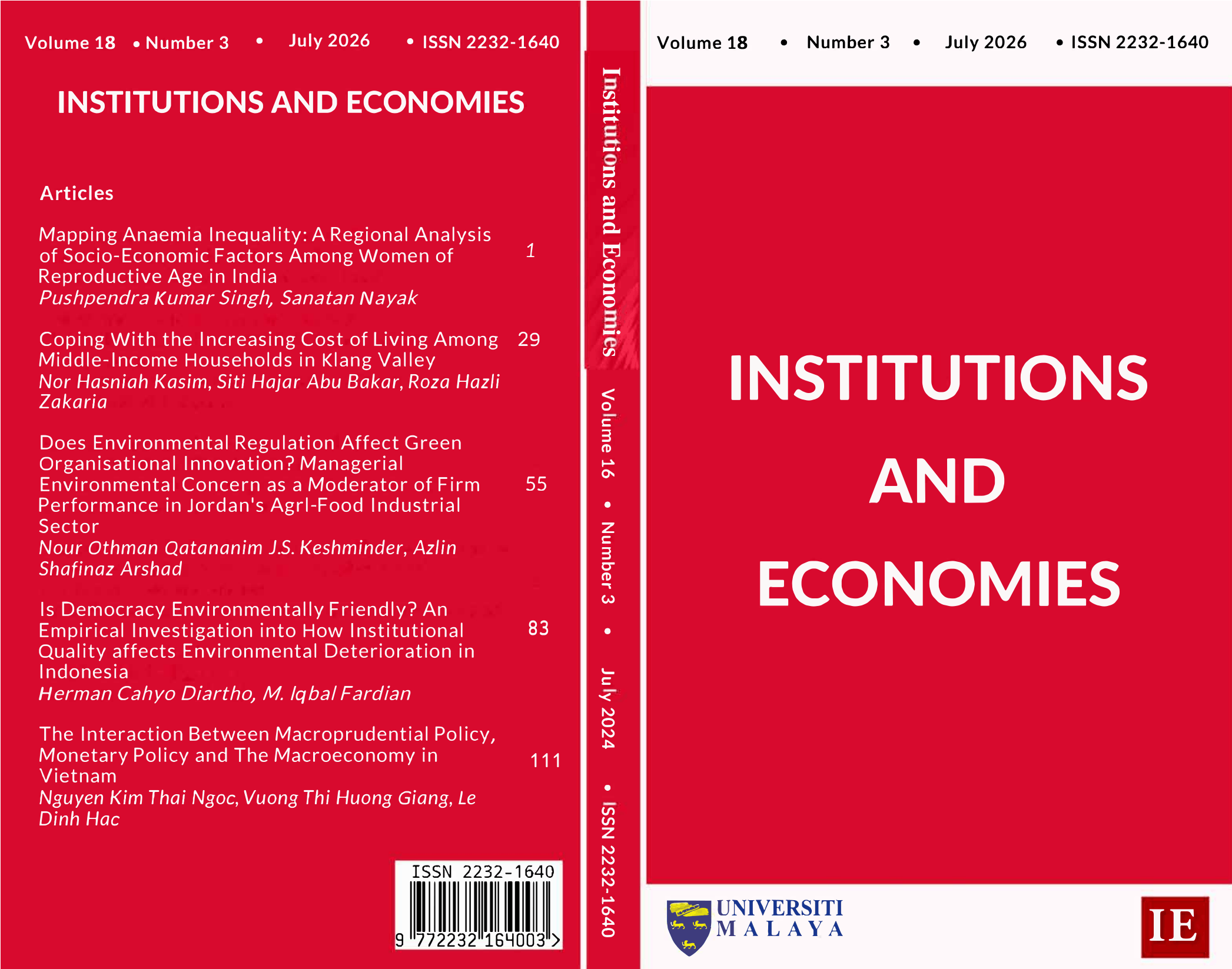
Is Democracy Environmentally Friendly? An Empirical Investigation into How Institutional Quality affects Environmental Deterioration in Indonesia
DOI:
https://doi.org/10.22452/JIE.vol18no3.4Keywords:
Institutional quality, Democracy, Environmental degradation, STIRPAT, ARDLAbstract
This study investigates the impact of democracy on environmental degradation
in Indonesia using the autoregressive distributed lag (ARDL) model over the period of
1971 to 2018. The analysis employs the STIRPAT framework to assess how institutional
quality, energy structure, and other factors affect carbon dioxide emissions. The results
show that institutional quality has a significant effect on environmental degradation
in the short term, but becomes statistically insignificant in the long term. Meanwhile,
energy structure—measured by the share of fossil fuels in total energy consumption—
positively and significantly affects environmental degradation in both time horizons.
These findings highlight the critical role of transitioning to renewable energy and
improving governance quality. Although democracy has the potential to foster better
environmental outcomes through transparency and citizen participation, the study
reveals that in Indonesia, democratic institutions may also enable environmentally
harmful practices due to weak enforcement and short-term political incentives. Therefore,
effective environmental governance requires not only democratic mechanisms but
also strong, transparent institutions. Policy recommendations include strengthening
institutional accountability, increasing public access to environmental information, and
promoting energy diversification to ensure sustainable development.
Downloads
Published
Issue
Section
License
Submission of a manuscript implies: that the work described is original, has not been published before (except in the form of an abstract or as part of a published lecture, review, or thesis); that is not under consideration for publication elsewhere; that its publication has been approved by all co-authors, if any, as well as tacitly or explicitly by the responsible authorities at the institution where the work was carried out. Transfer of copyright to the University of Malaya becomes effective if and when the article is accepted for publication. The copyright covers the exclusive right to reproduce and distribute the article, including reprints, translations, photographic reproductions, microform, electronic form (offline and online) or other reproductions of similar nature.
An author may self-archive the English language version of his/her article on his/her own website and his/her institutions repository; however he/she may not use the publishers PDF version which is posted on www.ijie.um.edu.my. Furthermore, the author may only post his/her version, provided acknowledgement is given to the original source of publication and a link must be accompanied by the following text: The original publication is available at www.ijie.um.edu.my.
All articles published in this journal are protected by copyright, which covers the exclusive rights to reproduce and redistribute the article (e.g. as offprint), as well as all translation rights. No material published in this journal may be reproduced photographically or stored on microfilm, in electronic database, video disks, etc., without first obtaining written permission from the publishers. The use of general descriptive names, trade names, trademarks, etc., in this publication, even if not specifically identified, does not imply that these names are not protected by the relevant laws and regulations.
The copyright owners consent does not include copying for general distribution, promotion, new works, or resale. In these cases, specific written permission must first be obtained from the publishers.