Examine Horizontal Resolution of Dipole-Dipole Array Using Synthetic Models Of 2D and 3D Tomography Techniques
DOI:
https://doi.org/10.22452/Keywords:
Horizontal Resolution, Dipole-Dipole Array, 2D and 3D Tomography TechniquesAbstract
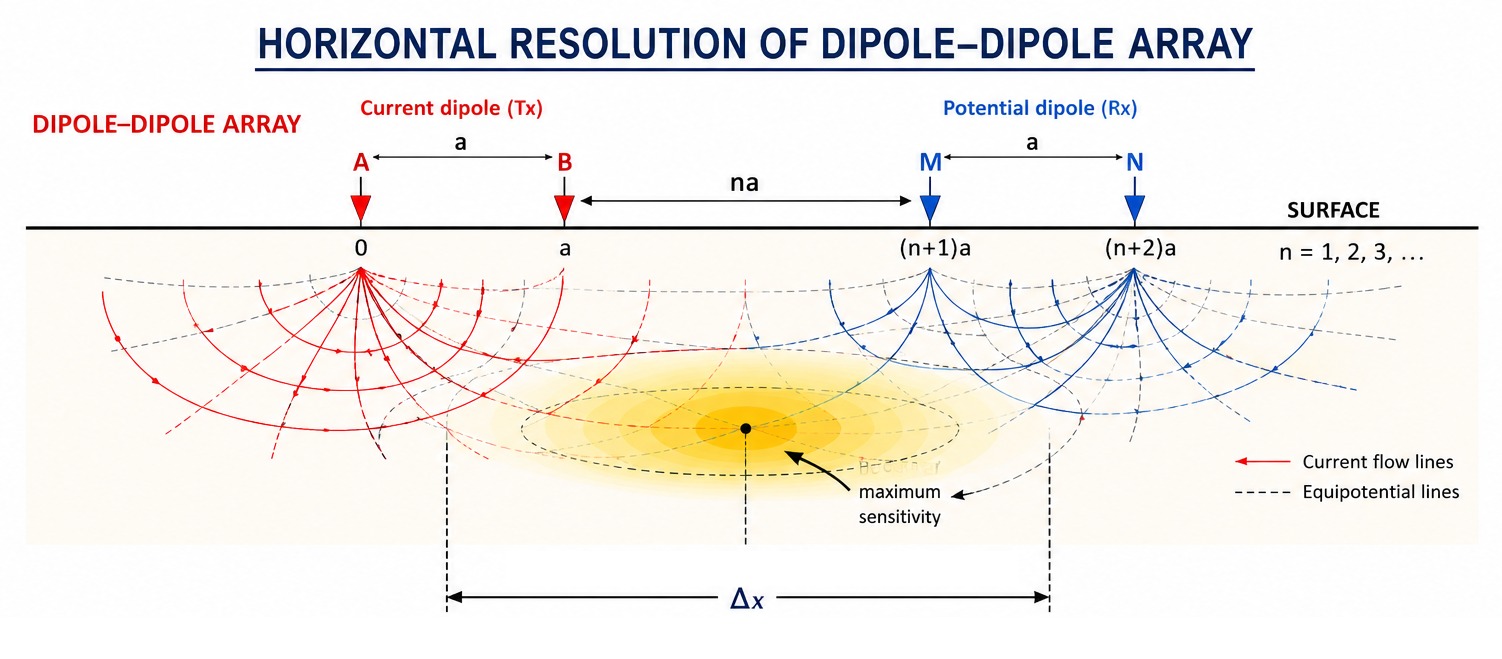
The horizontal resolution of the array is the most important factor in accurately mapping subsurface features and ensuring reliable geological interpretations in electrical resistivity surveys. Therefore, six two-dimensional (2D) and three-dimensional (3D) synthetic models were used to assess the horizontal resolution of the Dipole-Dipole array. In each synthetic model, two identical structures with a resistivity of 100Ωm are embedded within a medium of 30Ωm. The horizontal distance between the structures is varied between 2m, 3m, and 4m. The results revealed that the Dipole-Dipole array shows difficulties in delineating the exact location and size of the structures. It provides a distorted image of the structures' locations. It shows better resolution with 2D inverse models compared to 3D inverse models when the horizontal distance becomes small. The sensitivity of this array to the horizontal change in resistivity is increased when the distance between the structures is increased. In the 3D inverse models, Dipole-Dipole array generated a distorted image of the structures when the horizontal distance between the structures is small, while it provides reasonable images when the distance between the structures is increased. So, for investigating a subsurface horizontal structure that is separated with small distances, 2D tomography technique is a better approach than 3D tomography technique when using Dipole-Dipole array.
References
Al-Awsi, M.D. and Abdulrazzaq, Z.T., 2022. Implementing electrical resistivity tomography to delineate soil contamination zone, Southern Baqubah City, Iraq. Kuwait Journal of Science, 49(2), pp. 1-15. https://doi.org/10.48129/kjs.10674
Al-Hameedawie, M.A., 2013. Comparison between different electrode arrays in delineating aquifer boundary by using 1D and 2D techniques in north Badra area eastern Iraq (Doctoral dissertation, M. Sc. Thesis Department of Geology, college of Science, University of Baghdad, Iraq, 142p).
Al-Khersan, E.H., Al-Ani, J.M. and Abrahem, S.N., 2016. Integrated GPR and ERT as enhanced detection for subsurface historical structures inside Babylonian houses site, Uruk City, southern Iraq. Pure and Applied Geophysics, 173, pp.963-982. https://doi.org/10.1007/s00024-015-1162-2
Alpin L.M. 1966. The theory of dipole sounding. In: Dipole Methods for Measuring Earth Conductivity, pp. 1–60. Consult Bureau, New York.
Al‐Zubedi, A.S. and Thabit, J.M., 2016. A comparison between 2D azimuthal and 3D resistivity imaging techniques in determining the subsurface fracture zones within Abu‐Jir Fault Zone, Southwest Karbala, Central Iraq. Near Surface Geophysics, 14(5), pp.413-421. https://doi.org/10.3997/1873-0604.2016020
Al-Zubedi, A.S. and Thabit, J.M., 2016. Use of 2D azimuthal resistivity imaging in delineation of the fracture characteristics in Dammam aquifer within and out of Abu-Jir fault zone, central Iraq. Arabian Journal of Geosciences, 9(1), p.22. https://doi.org/10.1007/s12517-015-2070-6
Al-Zubedi, A.S., 2016. Evaluation of five electrode arrays in imaging subsurface shallow targets: A case study. Iraqi Bulletin of Geology and Mining, 12(2), pp.39-46.
Chitea, F. and Georgescu, P., 2009. Sensitivity function for various geoelectric arrays. In Geophysical Research Abstracts. University of Bucharest, Faculty of Geology and Geophysics.
Claerbout, J.F. and Muir, F., 1973. Robust modeling with erratic data. Geophysics, 38(5), pp.826-844.
Dahlin, T. and Zhou, B., 2004. A numerical comparison of 2D resistivity imaging with 10 electrode arrays. Geophysical prospecting, 52(5), pp.379-398. https://doi.org/10.1111/j.1365-2478.2004.00423.x
Kallweit, R.S. and Wood, L.C., 1982. The limits of resolution of zero-phase wavelets. Geophysics, 47(7), pp.1035-1046. https://doi.org/10.1190/1.1441367
Keller, G.V., Frischknecht, F.C., 1966. Electrical methods in geophysical prospecting. Pergamon Press, London, England, Oxford, 519p.
Kemna, A., Vanderborght, J., Kulessa, B. and Vereecken, H., 2002. Imaging and characterisation of subsurface solute transport using electrical resistivity tomography (ERT) and equivalent transport models. Journal of hydrology, 267(3-4), pp.125-146. https://doi.org/10.1016/S0022-1694(02)00145-2
Kunetz, G., 1966. Principles of direct current resistivity prospecting. Borntraeger, Stuttgart, Germany, 106 p.
Loke, M. H., 2012. Tutorial: 2-D and 3D Electrical Imaging Surveys, 172p.
Loke, M. H., 2020. Tutorial: 2-D and 3D Electrical Imaging Surveys, 221p.
Loke, M.H., Chambers, J.E., Rucker, D.F., Kuras, O. and Wilkinson, P.B., 2013. Recent developments in the direct-current geoelectrical imaging method. Journal of applied geophysics, 95, pp.135-156. https://doi.org/10.1016/j.jappgeo.2013.02.017
Olayinka, A.I. and Yaramanci, U., 2000. Assessment of the reliability of 2D inversion of apparent resistivity data [Link]. Geophysical Prospecting, 48(2), pp.293-316. https://doi.org/10.1046/j.1365-2478.2000.00173.x
Roy, A., and A. Apparao. "Depth of investigation in direct current methods." Geophysics 36, no. 5 (1971): 943-959. https://doi.org/10.1190/1.1440226
Tamssar, A.H., 2013. An evaluation of the suitability of different electrode arrays for geohydrological studies in karoo rocks using electrical resistivity tomography (Doctoral dissertation, University of the Free State).
Thabit, J.M. and Al-Zubedi, A.S., 2015. Evaluation of three important electrode arrays in defining the vertical and horizontal structures in 2D imaging surveys. Iraqi Journal of Science, pp.1465-1470.
Zhou, Q.Y., Matsui, H. and Shimada, J., 2004. Characterization of the unsaturated zone around a cavity in fractured rocks using electrical resistivity tomography. Journal of Hydraulic Research, 42(S1), pp.25-31. https://doi.org/10.1080/00221680409500044
Zhou, W., Beck, B.F. and Adams, A.L., 2002. Effective electrode array in mapping karst hazards in electrical resistivity tomography. Environmental geology, 42, pp.922-928. https://doi.org/10.1007/s00254-002-0594-z
Downloads
Published
Issue
Section
License
Copyright (c) 2026 Malaysian Journal of Science (MJS)

This work is licensed under a Creative Commons Attribution-NonCommercial 4.0 International License.
Transfer of Copyrights
- In the event of publication of the manuscript entitled [INSERT MANUSCRIPT TITLE AND REF NO.] in the Malaysian Journal of Science, I hereby transfer copyrights of the manuscript title, abstract and contents to the Malaysian Journal of Science and the Faculty of Science, University of Malaya (as the publisher) for the full legal term of copyright and any renewals thereof throughout the world in any format, and any media for communication.
Conditions of Publication
- I hereby state that this manuscript to be published is an original work, unpublished in any form prior and I have obtained the necessary permission for the reproduction (or am the owner) of any images, illustrations, tables, charts, figures, maps, photographs and other visual materials of whom the copyrights is owned by a third party.
- This manuscript contains no statements that are contradictory to the relevant local and international laws or that infringes on the rights of others.
- I agree to indemnify the Malaysian Journal of Science and the Faculty of Science, University of Malaya (as the publisher) in the event of any claims that arise in regards to the above conditions and assume full liability on the published manuscript.
Reviewer’s Responsibilities
- Reviewers must treat the manuscripts received for reviewing process as confidential. It must not be shown or discussed with others without the authorization from the editor of MJS.
- Reviewers assigned must not have conflicts of interest with respect to the original work, the authors of the article or the research funding.
- Reviewers should judge or evaluate the manuscripts objective as possible. The feedback from the reviewers should be express clearly with supporting arguments.
- If the assigned reviewer considers themselves not able to complete the review of the manuscript, they must communicate with the editor, so that the manuscript could be sent to another suitable reviewer.
Copyright: Rights of the Author(s)
- Effective 2007, it will become the policy of the Malaysian Journal of Science (published by the Faculty of Science, University of Malaya) to obtain copyrights of all manuscripts published. This is to facilitate:
- Protection against copyright infringement of the manuscript through copyright breaches or piracy.
- Timely handling of reproduction requests from authorized third parties that are addressed directly to the Faculty of Science, University of Malaya.
- As the author, you may publish the fore-mentioned manuscript, whole or any part thereof, provided acknowledgement regarding copyright notice and reference to first publication in the Malaysian Journal of Science and Faculty of Science, University of Malaya (as the publishers) are given. You may produce copies of your manuscript, whole or any part thereof, for teaching purposes or to be provided, on individual basis, to fellow researchers.
- You may include the fore-mentioned manuscript, whole or any part thereof, electronically on a secure network at your affiliated institution, provided acknowledgement regarding copyright notice and reference to first publication in the Malaysian Journal of Science and Faculty of Science, University of Malaya (as the publishers) are given.
- You may include the fore-mentioned manuscript, whole or any part thereof, on the World Wide Web, provided acknowledgement regarding copyright notice and reference to first publication in the Malaysian Journal of Science and Faculty of Science, University of Malaya (as the publishers) are given.
- In the event that your manuscript, whole or any part thereof, has been requested to be reproduced, for any purpose or in any form approved by the Malaysian Journal of Science and Faculty of Science, University of Malaya (as the publishers), you will be informed. It is requested that any changes to your contact details (especially e-mail addresses) are made known.
Copyright: Role and responsibility of the Author(s)
- In the event of the manuscript to be published in the Malaysian Journal of Science contains materials copyrighted to others prior, it is the responsibility of current author(s) to obtain written permission from the copyright owner or owners.
- This written permission should be submitted with the proof-copy of the manuscript to be published in the Malaysian Journal of Science
Licensing Policy
Malaysian Journal of Science is an open-access journal that follows the Creative Commons Attribution-Non-commercial 4.0 International License (CC BY-NC 4.0)
CC BY – NC 4.0: Under this licence, the reusers to distribute, remix, alter, and build upon the content in any media or format for non-commercial purposes only, as long as proper acknowledgement is given to the authors of the original work. Please take the time to read the whole licence agreement (https://creativecommons.org/licenses/by-nc/4.0/legalcode ).