Comparative Performance Analysis of Interpolative Decomposition and Singular Value Decomposition for Image Reduction
DOI:
https://doi.org/10.22452/Keywords:
Interpolative decomposition, singular value decomposition, image reductionAbstract
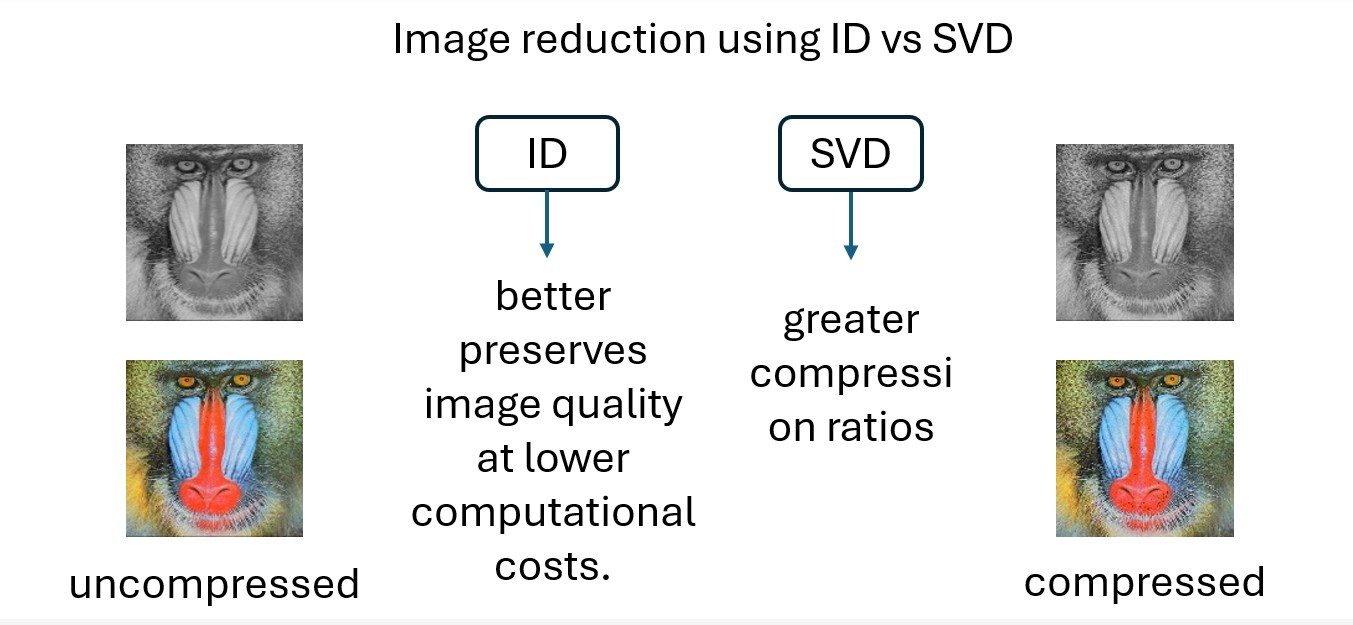
Matrix decomposition techniques, such as Singular Value Decomposition (SVD), have traditionally been used for image compression, achieving data reduction while preserving image fidelity. Recently, randomised linear algebra algorithms, including Interpolative Decomposition (ID), have gained attention due to their efficiency in computational expense and memory consumption. This study presents a comparative analysis of ID and randomised SVD for image compression using a large collection of images from the USC-SIPI Image Database. Experimental results demonstrate that both methods effectively reduce image sizes, with SVD yielding greater compression ratios, while ID better preserves image quality at lower computational costs. The analysis also demonstrated that both techniques faced limitations when compressing images with dark or low-contrast areas, with ID performing best on images exhibiting repetitive or structured patterns. These findings indicate that ID is more suitable for memory-limited applications, such as reducing large tabular data, which is important in marketing data analysis, whereas SVD is preferable for image compression.
References
Achlioptas, D., McSherry, F. (2001) Fast computation of low rank matrix approximations. In Proceedings of the thirty-third annual ACM symposium on Theory of computing (STOC '01). Association for Computing Machinery, New York, NY, USA, 611–618. https://doi.org/10.1145/380752.380858
Bentbib A.H., Kreit K., Labaali I. (2022) Randomized tensor singular value decomposition for multidimensional data compression. In 2022 11th International Symposium on Signal, Image, Video and Communications (ISIVC) (pp. 1-6). El Jadida, Morocco: IEEE.
Bhaskara A., Lattanzi S., Vassilvitskii S., Zadimoghaddam M. (2020) Residual based sampling for online low rank approximation. In 2020 Information Theory and Applications Workshop (ITA). (pp. 1-19). San Diego, CA, USA: IEEE.
Damle A., Lin L., Ying L. (2017) SCDM-k: Localized orbitals for solids via selected columns of the density matrix. Journal of Computational Physics 334: 1-15.
Golub G. (1965) Numerical methods for solving linear least squares problems. Numerische Mathematik, 7(3):206-216.
Kawamura H., Suda R. (2021) Least upper bound of truncation error of low-rank matrix approximation algorithm using QR decomposition with pivoting. Japan Journal of Industrial and Applied Mathematics, 38(3):757-779.
Kiran, Parameshachari B.D., Kumar D.S., Prafulla P.S., Yashwanth J. (2023) Singular Value Decomposition (SVD) based optimal image compression technique. In 2023 International Conference on Evolutionary Algorithms and Soft Computing Techniques (EASCT) (pp. 1-6). Bengaluru, India: IEEE.
Khoei, Tala T., Singh, A. (2024) Data reduction in big data: a survey of methods, challenges and future directions, International Journal of Data Science and Analytics, 2364-4168.
Kiran, Parameshachari B.D., Kumar D.S., Prafulla P.S., Yashwanth J. (2023) Singular Value Decomposition (SVD) based optimal image compression technique. In 2023 International Conference on Evolutionary Algorithms and Soft Computing Techniques (EASCT) (pp. 1-6). Bengaluru, India: IEEE.
Libal U., Baras J.S., Johansson K.H. (2020) Dimensionality reduction of volterra kernels by tensor decomposition using higher-order SVD. In 2020 59th IEEE Conference on Decision and Control (CDC) (pp. 5935-5941). Jeju, Korea (South): IEEE.
Liberty E., Woolfe F., Martinsson P.G., Rokhlin V., Tygert, M. (2007). Randomized algorithms for the low-rank approximation of matrices. Proceedings of the National Academy of Sciences 104(51): 20167-20172.
Liu W., He M. (2019) Accelerating solution of volume-surface integral equations with multiple right-hand sides by improved skeletonization techniques. IEEE Antennas and Wireless Propagation Letters 18(10):2006-2010.
Lu J., Ying L. (2015) Compression of the electron repulsion integral tensor in tensor hypercontraction format with cubic scaling cost. Journal of Computational Physics 302:329-335.
Mersereau R.M. (1979) The processing of hexagonally sampled two-dimensional signals. Proceedings of the IEEE 67(6):930-949.
Muravev A., Tran D.T., Iosifidis A., Kiranyaz S., Gabbouj M. (2018) Acceleration approaches for big data analysis. In 2018 25th IEEE International Conference on Image Processing (ICIP) (pp. 311-315). Athens: IEEE.
Su Q., Wang G., Zhang X., Lv G., Chen B. (2018) A new algorithm of blind color image watermarking based on LU decomposition. Multidimensional Systems and Signal Processing, 29(3):1055-1074.
Tang W.K.A., Ng W.S., Liew, H.H. (2023) Separation of two musical instruments using matrix factorisation techniques. International Journal of Applied Mathematics 36(3):425.
Varghese P., Saroja G.A.S. (2021) Hexagonal image compression using singular value decomposition in Python. In 2021 2nd International Conference on Advances in Computing, Communication, Embedded and Secure Systems (ACCESS) (pp. 211-215). IEEE.
Wüthrich C.A., Stucki P. (1991). An algorithmic comparison between square-and hexagonal-based grids. CVGIP: Graphical Models and Image Processing, 53(4):324-339.
Downloads
Published
Issue
Section
License
Copyright (c) 2026 Malaysian Journal of Science (MJS)

This work is licensed under a Creative Commons Attribution-NonCommercial 4.0 International License.
Transfer of Copyrights
- In the event of publication of the manuscript entitled [INSERT MANUSCRIPT TITLE AND REF NO.] in the Malaysian Journal of Science, I hereby transfer copyrights of the manuscript title, abstract and contents to the Malaysian Journal of Science and the Faculty of Science, University of Malaya (as the publisher) for the full legal term of copyright and any renewals thereof throughout the world in any format, and any media for communication.
Conditions of Publication
- I hereby state that this manuscript to be published is an original work, unpublished in any form prior and I have obtained the necessary permission for the reproduction (or am the owner) of any images, illustrations, tables, charts, figures, maps, photographs and other visual materials of whom the copyrights is owned by a third party.
- This manuscript contains no statements that are contradictory to the relevant local and international laws or that infringes on the rights of others.
- I agree to indemnify the Malaysian Journal of Science and the Faculty of Science, University of Malaya (as the publisher) in the event of any claims that arise in regards to the above conditions and assume full liability on the published manuscript.
Reviewer’s Responsibilities
- Reviewers must treat the manuscripts received for reviewing process as confidential. It must not be shown or discussed with others without the authorization from the editor of MJS.
- Reviewers assigned must not have conflicts of interest with respect to the original work, the authors of the article or the research funding.
- Reviewers should judge or evaluate the manuscripts objective as possible. The feedback from the reviewers should be express clearly with supporting arguments.
- If the assigned reviewer considers themselves not able to complete the review of the manuscript, they must communicate with the editor, so that the manuscript could be sent to another suitable reviewer.
Copyright: Rights of the Author(s)
- Effective 2007, it will become the policy of the Malaysian Journal of Science (published by the Faculty of Science, University of Malaya) to obtain copyrights of all manuscripts published. This is to facilitate:
- Protection against copyright infringement of the manuscript through copyright breaches or piracy.
- Timely handling of reproduction requests from authorized third parties that are addressed directly to the Faculty of Science, University of Malaya.
- As the author, you may publish the fore-mentioned manuscript, whole or any part thereof, provided acknowledgement regarding copyright notice and reference to first publication in the Malaysian Journal of Science and Faculty of Science, University of Malaya (as the publishers) are given. You may produce copies of your manuscript, whole or any part thereof, for teaching purposes or to be provided, on individual basis, to fellow researchers.
- You may include the fore-mentioned manuscript, whole or any part thereof, electronically on a secure network at your affiliated institution, provided acknowledgement regarding copyright notice and reference to first publication in the Malaysian Journal of Science and Faculty of Science, University of Malaya (as the publishers) are given.
- You may include the fore-mentioned manuscript, whole or any part thereof, on the World Wide Web, provided acknowledgement regarding copyright notice and reference to first publication in the Malaysian Journal of Science and Faculty of Science, University of Malaya (as the publishers) are given.
- In the event that your manuscript, whole or any part thereof, has been requested to be reproduced, for any purpose or in any form approved by the Malaysian Journal of Science and Faculty of Science, University of Malaya (as the publishers), you will be informed. It is requested that any changes to your contact details (especially e-mail addresses) are made known.
Copyright: Role and responsibility of the Author(s)
- In the event of the manuscript to be published in the Malaysian Journal of Science contains materials copyrighted to others prior, it is the responsibility of current author(s) to obtain written permission from the copyright owner or owners.
- This written permission should be submitted with the proof-copy of the manuscript to be published in the Malaysian Journal of Science
Licensing Policy
Malaysian Journal of Science is an open-access journal that follows the Creative Commons Attribution-Non-commercial 4.0 International License (CC BY-NC 4.0)
CC BY – NC 4.0: Under this licence, the reusers to distribute, remix, alter, and build upon the content in any media or format for non-commercial purposes only, as long as proper acknowledgement is given to the authors of the original work. Please take the time to read the whole licence agreement (https://creativecommons.org/licenses/by-nc/4.0/legalcode ).