Cocoa Agro-Industry Development Based on Pyrolysis Technology with Cocoa Liquid Smoke, Biochar and Bio-Oil Product
DOI:
https://doi.org/10.22452/Keywords:
Agro-industry, cocoa husk, cocoa pod, liquid smoke, pyrolysisAbstract
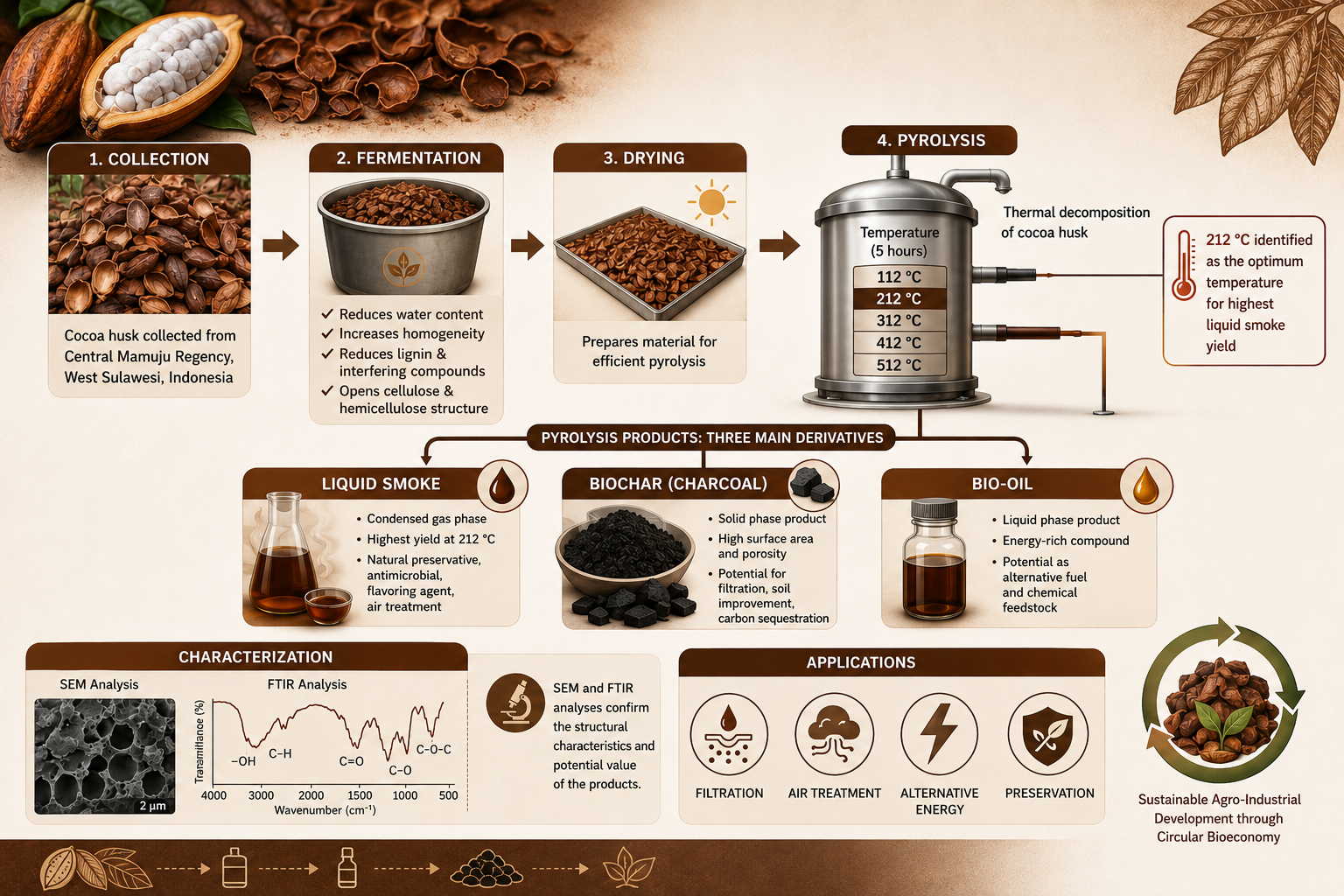
This study aims to analyze the utilization of cocoa husk through fermentation and pyrolysis processes into three main derivative products, namely liquid smoke, charcoal (biochar), and bio-oil. Cocoa husk was collected from cocoa fruit in Central Mamuju Regency, West Sulawesi Province. Before the pyrolysis process, the cocoa husk was fermented to reduce water content, increase homogeneity, and reduce interfering compounds such as complex lignin. Fermentation also increases pyrolysis efficiency by opening the cellulose and hemicellulose structures. After fermentation, the cocoa husk was dried and fed into a pyrolysis reactor with combustion temperatures of 112, 212, 312, 412, and 512°C for 5 hours. During the pyrolysis process, the cocoa husk decomposed into three main phases: the solid phase produced biochar, the liquid phase produced bio-oil, and the gas formed during pyrolysis was condensed into liquid smoke. The experimental results showed that temperature plays an important role in determining the amount of liquid smoke product produced. A temperature of 212°C is considered the optimum temperature to obtain the highest liquid smoke yield. This process not only increases the efficiency of cocoa shell waste utilization, but also produces products that can be applied in various industries, such as filtration, air treatment, alternative energy, and preservation. SEM and FTIR analysis show the potential and value of the resulting products in accordance with the principles of sustainable agro-industrial development and circular bioeconomy.
References
Akinola, A. O., Eiche, J. F., Owolabi, P. O., & Elegbeleye, A. P. (2018). Pyrolytic analysis of cocoa pod for biofuel production. Nigerian Journal of Technology, 37(4), 1026. https://doi.org/10.4314/njt.v37i4.23
Anca-Couce, A. (2016). Reaction mechanisms and multi-scale modelling of lignocellulosic biomass pyrolysis. Progress in Energy and Combustion Science, 53, 41–79. https://doi.org/10.1016/j.pecs.2015.10.002
Aneani, F., Adu-Acheampong, R., & Sakyi-Dawson, O. (2017). Exploring Opportunities for Enhancing Innovation in Agriculture: The Case of Cocoa (Theobroma cacao L.) Production in Ghana. Sustainable Agriculture Research, 7(1), 33. https://doi.org/10.5539/sar.v7n1p33
Budaraga, I. K., & Aga Salihat, R. (2019). Study of chemical components of liquid smoke from cocoa rind in two variations of moisture content by using GC-MS method. IOP Conference Series: Earth and Environmental Science, 383(1). https://doi.org/10.1088/1755-1315/383/1/012023
Budaraga, I. K., & Putra, D. P. (2020). Characteristics of the liquid chemical properties of cocoa skin [Theobroma cacao L.] in different water levels. IOP Conference Series: Earth and Environmental Science, 497(1), 497. https://doi.org/10.1088/1755-1315/497/1/012016
Budaraga, I. K., Putra, D. P., & Yanti, Y. (2022). Microbial activities and minimum liquid smoke killing concentration made of cacao pod toward Lasiodiplodia theobromae growth. IOP Conference Series: Earth and Environmental Science, 1059(1). https://doi.org/10.1088/1755-1315/1059/1/012068
Budaraga, I. K., Susanti, E., Asnurita, A., Nurdin, E., & Ramaiyulis, R. (2019). The Antioxidant Characteristics of The Liquid Smoke of Cocoa Shell ( Theobroma cacao, l ) In Different Water Content Variations. Journal of Applied Agricultural Science and Technology, 3(2), 226–238. https://doi.org/10.32530/jaast.v3i2.106
Chen, L., Liao, Y., Guo, Z., Cao, Y., & Ma, X. (2019). Products distribution and generation pathway of cellulose pyrolysis. Journal of Cleaner Production, 232, 1309–1320. https://doi.org/10.1016/j.jclepro.2019.06.026
Cilas, C., & Bastide, P. (2020). Challenges to Cocoa Production in the Face of Climate Change and the Spread of Pests and Diseases. Agronomy, 10(9), 1–8. https://doi.org/10.3390/agronomy10091232
Du, Y., Jiang, X., Lv, G., Li, X., Chi, Y., Yan, J., Liu, X., & Buekens, A. (2014). TG-pyrolysis and FTIR analysis of chocolate and biomass waste. Journal of Thermal Analysis and Calorimetry, 117(1), 343–353. https://doi.org/10.1007/s10973-014-3741-3
Fahmid, I. M., Wahyudi, Salman, D., Kariyasa, I. K., Fahmid, M. M., Agustian, A., Perdana, R. P., Rachman, B., Darwis, V., & Mardianto, S. (2022). “Downstreaming” Policy Supporting the Competitiveness of Indonesian Cocoa in the Global Market. In Frontiers in Sustainable Food Systems (Vol. 6, p. 6). https://doi.org/10.3389/fsufs.2022.821330
Feby, P., Sari, D., & Kholil, A. Y. (2021). Prospective Analysis of Cocoa (Theobrema Cacao L.) Production in Indonesia. SSRN Electronic Journal. https://doi.org/10.2139/ssrn.3862646
Hafiz, A., & Verawati, V. (2021). Sistem Pakar Penyakit Buah Kakao Untuk Peningkatan Hasil Panen Kakao Menggunakan Metode Case Base Reasoning (Cbr) Berbasis Web Mobile. Jurnal Informasi Dan Komputer, 9(2), 89–94. https://doi.org/10.35959/jik.v9i2.226
Hanafi, R. U., & Tinaprilla, N. (2017). Daya Saing Komoditas Kakao Indonesia Di Perdagangan Internasional. Forum Agribisnis, 7(1), 1–20. https://doi.org/10.29244/fagb.7.1.1-20
Handojo, L., Cherilisa, & Indarto, A. (2020). Cocoa bean skin waste as potential raw material for liquid smoke production. Environmental Technology (United Kingdom), 41(8), 1044–1053. https://doi.org/10.1080/09593330.2018.1520306
Izzah, N., & Damayanti, D. (2023). Pengaruh Jumlah Produksi dan Harga terhadap Nilai Ekspor Kakao Indonesia Tahun 2017-2020. Transparansi : Jurnal Ilmiah Ilmu Administrasi, 6(1), 78–85. https://doi.org/10.31334/transparansi.v6i1.3108
Juradi, M. A., Tando, E., & Suwitra, K. (2019). Inovasi Teknologi Pemanfaatan Limbah Kulit Buah Kakao (Theobroma cacao L.) Sebagai Pupuk Organik Ramah Lingkungan. AGRORADIX : Jurnal Ilmu Pertanian, 2(2), 9–17. https://doi.org/10.52166/agroteknologi.v2i2.1586
Kartal, S. N., Imamura, Y., Tsuchiya, F., & Ohsato, K. (2004). Preliminary evaluation of fungicidal and termiticidal activities of filtrates from biomass slurry fuel production. Bioresource Technology, 95(1), 41–47. https://doi.org/10.1016/j.biortech.2004.02.005
Kouadio, D. L., Djassou, A. C., Koffi, A. L. C., & Traore, K. S. (2019). Development of materials for environmental pollution control from cocoa pod shells. International Journal of Engineering and Applied Sciences (IJEAS), 6(10). https://doi.org/10.31873/ijeas.6.10.12
Londoño-Larrea, P., Villamarin-Barriga, E., García, A. N., & Marcilla, A. (2022). Study of Cocoa Pod Husks Thermal Decomposition. Applied Sciences (Switzerland), 12(18). https://doi.org/10.3390/app12189318
Masulili, A., Astar, I., Suci, I. A., & Paiman. (2024). Maximizing cocoa (Theobroma cacao L.) seedling growth through liquid coconut shell smoke in Ultisols soil. Research on Crops, 25(1), 128–134. https://doi.org/10.31830/2348-7542.2024.ROC-1043
Maulana, A., & Kartiasih, F. (2017). Analisis Ekspor Kakao Olahan Indonesia ke Sembilan Negara Tujuan Tahun 2000–2014. Jurnal Ekonomi Dan Pembangunan Indonesia, 17(2), 103–117. https://doi.org/10.21002/jepi.v17i2.664
Mohanty, A., Ajmera, S., Chinnam, S., Kumar, V., Mishra, R. K., & Acharya, B. (2024). Pyrolysis of waste oils for biofuel production: An economic and life cycle assessment. Fuel Communications, 18(January), 100108. https://doi.org/10.1016/j.jfueco.2024.100108
Moldoveanu, S. C. (2019). General Information About Pyrolysis. In Pyrolysis of Organic Molecules (pp. 1–33). https://doi.org/10.1016/b978-0-444-64000-0.00001-9
Mulyo, P. R., & Hariyati, Y. (2020). Dinamika Perkembangan Perkebunan Kakao Rakyat di Indonesia. Agriekonomika, 9(1), 48–60. https://doi.org/10.21107/agriekonomika.v9i1.7296
Mumbach, G. D., Alves, J. L. F., da Silva, J. C. G., Di Domenico, M., de Sena, R. F., Marangoni, C., Machado, R. A. F., & Bolzan, A. (2022). Pyrolysis of cocoa shell and its bioenergy potential: evaluating the kinetic triplet, thermodynamic parameters, and evolved gas analysis using TGA-FTIR. Biomass Conversion and Biorefinery, 12(3), 723–739. https://doi.org/10.1007/s13399-020-01058-5
Muslimah, M., Alham, F., Komariyah, S., & Lisa, N. P. (2023). Peningkatan Pengetahuan Petani Dalam Pengolahan Produk Hilir Kakao Di Kecamatan Rantau Peureulak. Jurnal Abdi Insani, 10(2), 1012–1020. https://doi.org/10.29303/abdiinsani.v10i2.864
Muslimin, Nersiwad, & Tallesang, M. (2017). the Potential and Supply Chain of Cocoa in the Central Sulawesi, Indonesia. Russian Journal of Agricultural and Socio-Economic Sciences, 67(7), 62–68. https://doi.org/10.18551/rjoas.2017-07.06
Shen, D., Jin, W., Hu, J., Xiao, R., & Luo, K. (2015). An overview on fast pyrolysis of the main constituents in lignocellulosic biomass to valued-added chemicals: Structures, pathways and interactions. Renewable and Sustainable Energy Reviews, 51, 761–774. https://doi.org/10.1016/j.rser.2015.06.054
Song, F., Li, T., Zhang, J., Wang, X., Bai, Y., Giesy, J. P., Xing, B., & Wu, F. (2019). Novel Insights into the Kinetics, Evolved Gases, and Mechanisms for Biomass (Sugar Cane Residue) Pyrolysis. Environmental Science and Technology, 53(22), 13495–13505. https://doi.org/10.1021/acs.est.9b04595
Supriyanto, Usino, D. O., Ylitervo, P., Dou, J., Sipponen, M. H., & Richards, T. (2020). Identifying the primary reactions and products of fast pyrolysis of alkali lignin. Journal of Analytical and Applied Pyrolysis, 151. https://doi.org/10.1016/j.jaap.2020.104917
Suryani, R., Rizal, W. A., Prasetyo, D. J., Apriyana, W., Anwar, M., & Wahono, S. K. (2023). Physicochemical Characteristics, Antioxidant and Antibacterial Activities of Liquid Smoke Derived from Mixed Sawdust and Cocoa Pod Husks Biomass. Trends in Sciences, 20(6). https://doi.org/10.48048/tis.2023.4985
Tsai, C. H., Tsai, W. T., Liu, S. C., & Lin, Y. Q. (2018). Thermochemical characterization of biochar from cocoa pod husk prepared at low pyrolysis temperature. Biomass Conversion and Biorefinery, 8(2), 237–243. https://doi.org/10.1007/s13399-017-0259-5
Wang, Q., Song, H., Pan, S., Dong, N., Wang, X., & Sun, S. (2020). Initial pyrolysis mechanism and product formation of cellulose: An Experimental and Density functional theory(DFT) study. Scientific Reports, 10(1). https://doi.org/10.1038/s41598-020-60095-2
Wang, S., Dai, G., Yang, H., & Luo, Z. (2017). Lignocellulosic biomass pyrolysis mechanism: A state-of-the-art review. Progress in Energy and Combustion Science, 62, 33–86. https://doi.org/10.1016/j.pecs.2017.05.004
Wijaya, M., Alam, M. N., & Wiharto, M. (2024). Characterization of Liquid Smoke and Charcoal from Cocoa Pod Husks (Theobroma cacao L .) in North Kolaka Regency. Jurnal Penelitian Pendidikan IPA, 10(12), 10417–10425. https://doi.org/10.29303/jppipa.v10i12.9185
Wijaya, M., Danial, M., Wiharto, M., & ... (2019). Production of charcoal and chemicals from cocoa waste by pyrolysis process with analysis Transmission Electron Microscopy (TEM). In … Conference on Education … (Vol. 2, pp. 419–424). https://series.gci.or.id/article/182/12/icestech-2019%0Ahttps://series.gci.or.id/assets/papers/icestech-2019-182.pdf
Yaman, S. (2004). Pyrolysis of biomass to produce fuels and chemical feedstocks. Energy Conversion and Management, 45(5), 651–671. https://doi.org/10.1016/S0196-8904(03)00177-8
Zhang, X., Zhang, P., Yuan, X., Li, Y., & Han, L. (2020). Effect of pyrolysis temperature and correlation analysis on the yield and physicochemical properties of crop residue biochar. Bioresource Technology, 296, 122318. https://doi.org/10.1016/j.biortech.2019.122318
Zong, P., Jiang, Y., Tian, Y., Li, J., Yuan, M., Ji, Y., Chen, M., Li, D., & Qiao, Y. (2020). Pyrolysis behavior and product distributions of biomass six group components: Starch, cellulose, hemicellulose, lignin, protein and oil. Energy Conversion and Management, 216. https://doi.org/10.1016/j.enconman.2020.112777
Zulfiandri. (2023). Grand strategy for accelerating the development of the cocoa processing industry in Indonesia. International Journal of Science and Technology Research Archive, 5(1), 050–062. https://doi.org/10.53771/ijstra.2023.5.1.0077
Downloads
Published
Issue
Section
License
Copyright (c) 2026 Malaysian Journal of Science (MJS)

This work is licensed under a Creative Commons Attribution-NonCommercial 4.0 International License.
Transfer of Copyrights
- In the event of publication of the manuscript entitled [INSERT MANUSCRIPT TITLE AND REF NO.] in the Malaysian Journal of Science, I hereby transfer copyrights of the manuscript title, abstract and contents to the Malaysian Journal of Science and the Faculty of Science, University of Malaya (as the publisher) for the full legal term of copyright and any renewals thereof throughout the world in any format, and any media for communication.
Conditions of Publication
- I hereby state that this manuscript to be published is an original work, unpublished in any form prior and I have obtained the necessary permission for the reproduction (or am the owner) of any images, illustrations, tables, charts, figures, maps, photographs and other visual materials of whom the copyrights is owned by a third party.
- This manuscript contains no statements that are contradictory to the relevant local and international laws or that infringes on the rights of others.
- I agree to indemnify the Malaysian Journal of Science and the Faculty of Science, University of Malaya (as the publisher) in the event of any claims that arise in regards to the above conditions and assume full liability on the published manuscript.
Reviewer’s Responsibilities
- Reviewers must treat the manuscripts received for reviewing process as confidential. It must not be shown or discussed with others without the authorization from the editor of MJS.
- Reviewers assigned must not have conflicts of interest with respect to the original work, the authors of the article or the research funding.
- Reviewers should judge or evaluate the manuscripts objective as possible. The feedback from the reviewers should be express clearly with supporting arguments.
- If the assigned reviewer considers themselves not able to complete the review of the manuscript, they must communicate with the editor, so that the manuscript could be sent to another suitable reviewer.
Copyright: Rights of the Author(s)
- Effective 2007, it will become the policy of the Malaysian Journal of Science (published by the Faculty of Science, University of Malaya) to obtain copyrights of all manuscripts published. This is to facilitate:
- Protection against copyright infringement of the manuscript through copyright breaches or piracy.
- Timely handling of reproduction requests from authorized third parties that are addressed directly to the Faculty of Science, University of Malaya.
- As the author, you may publish the fore-mentioned manuscript, whole or any part thereof, provided acknowledgement regarding copyright notice and reference to first publication in the Malaysian Journal of Science and Faculty of Science, University of Malaya (as the publishers) are given. You may produce copies of your manuscript, whole or any part thereof, for teaching purposes or to be provided, on individual basis, to fellow researchers.
- You may include the fore-mentioned manuscript, whole or any part thereof, electronically on a secure network at your affiliated institution, provided acknowledgement regarding copyright notice and reference to first publication in the Malaysian Journal of Science and Faculty of Science, University of Malaya (as the publishers) are given.
- You may include the fore-mentioned manuscript, whole or any part thereof, on the World Wide Web, provided acknowledgement regarding copyright notice and reference to first publication in the Malaysian Journal of Science and Faculty of Science, University of Malaya (as the publishers) are given.
- In the event that your manuscript, whole or any part thereof, has been requested to be reproduced, for any purpose or in any form approved by the Malaysian Journal of Science and Faculty of Science, University of Malaya (as the publishers), you will be informed. It is requested that any changes to your contact details (especially e-mail addresses) are made known.
Copyright: Role and responsibility of the Author(s)
- In the event of the manuscript to be published in the Malaysian Journal of Science contains materials copyrighted to others prior, it is the responsibility of current author(s) to obtain written permission from the copyright owner or owners.
- This written permission should be submitted with the proof-copy of the manuscript to be published in the Malaysian Journal of Science
Licensing Policy
Malaysian Journal of Science is an open-access journal that follows the Creative Commons Attribution-Non-commercial 4.0 International License (CC BY-NC 4.0)
CC BY – NC 4.0: Under this licence, the reusers to distribute, remix, alter, and build upon the content in any media or format for non-commercial purposes only, as long as proper acknowledgement is given to the authors of the original work. Please take the time to read the whole licence agreement (https://creativecommons.org/licenses/by-nc/4.0/legalcode ).