First Report and Molecular Identification of Sergentomyia babu babu Annandale (1910) (Diptera: Psychodidae: Phlebotominae) in Iraq
DOI:
https://doi.org/10.22452/Keywords:
Phlebotominae, Sandflies, leishmaniasis, Sergentomyia spp.Abstract
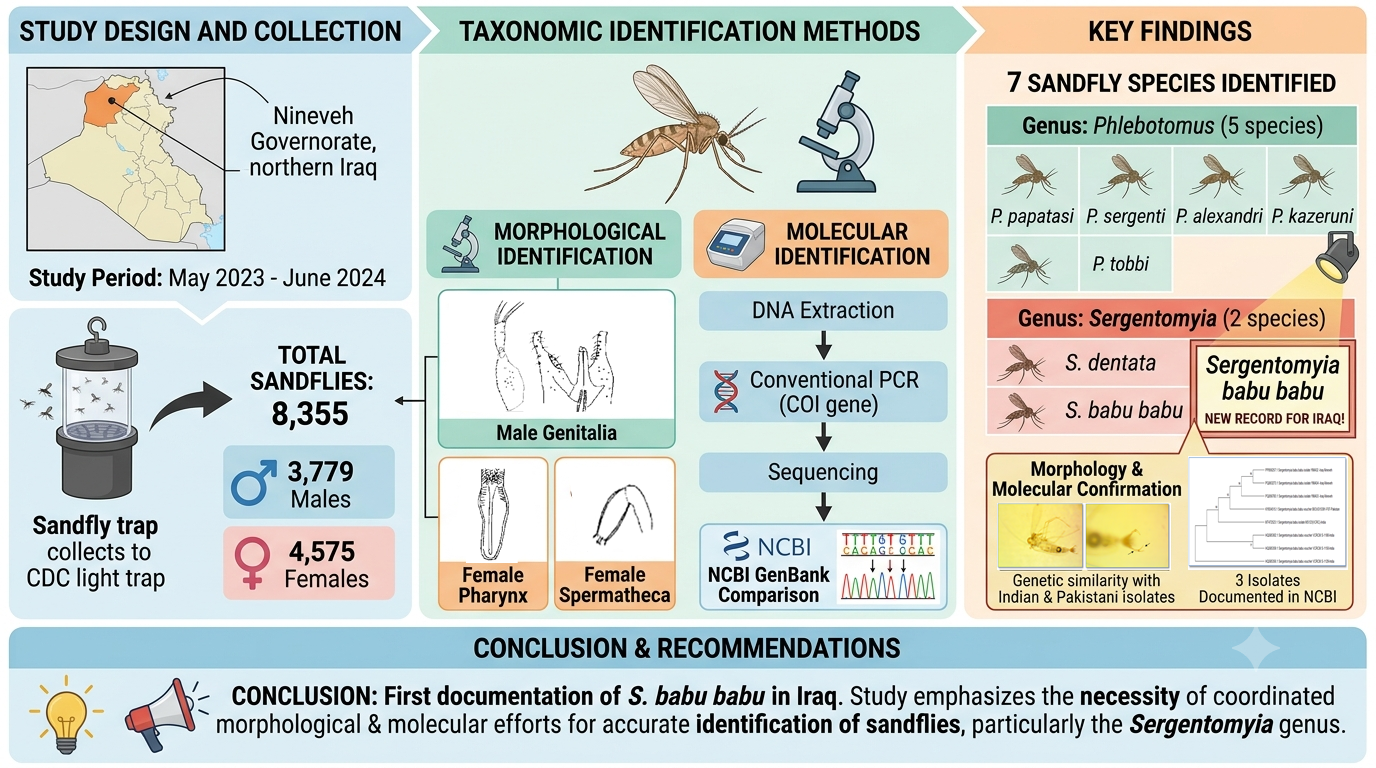
This study aims to investigate the morphology and molecular identification of sandflies, one of the most significant disease vectors in Iraq, across the provinces of Nineveh Governorate (northern Iraq) during the period between May 2023 and June 2024. The male genitalia, female pharynx and spermatheca of the subfamily Phlebotominae were used as the basis for the morphological identification. For molecular identification, the conventional polymerase chain reaction (PCR) was used to amplify the mitochondrial cytochrome c oxidase gene subunit 1 gene, and the DNA sequences were analyzed and compared to isolates listed in the National Center for Biotechnology Information (NCBI). The findings showed that 8,355 sandflies (3,779 males and 4,575 females) and seven species were collected, belonging to the two genera: Phlebotomus and Sergentomyia. The genus Phlebotomus includes five species: Phlebotomus papatasi, Phlebotomus sergenti, Phlebotomus alexandri, Phlebotomus kazeruni, and Phlebotomus tobbi. As for the genus Sergentomyia, it includes two species: Sergentomyia dentata and Sergentomyia babu babu. The results of phenotypic and molecular identification showed that the S. babu babu was recorded for the first time in Iraq, as three isolates were documented in NCBI. The evolutionary tree and genetic divergence analysis confirmed the great genetic similarity between S. babu babu and the Indian and Pakistani species, which confirms the correctness of the identification. This study is the second in the country to address the molecular identification of the Sergentomyia species. So, our emphasis is on the necessity of coordinating efforts to perform additional morphological and molecular taxonomic investigations in order to accurately identify the sandflies in Iraq, particularly those belonging to the genus Sergentomyia.
References
Abu Al-Hab, J.K. Medical and veterinary insects in Iraq, Theoretical Department, Baghdad University Press, University of Baghdad, Baghdad, Iraq, 451p.
Adler, S., Theodor, O. (1929). The distribution of sandflies and leishmaniasis in Palestine, Syria and Mesopotamia. Annals of Tropical Medicine & Parasitology, 23 (2): 269-306.
Al Joary, Y.I., Al Hamdani, M.A. (2024). First molecular identification of phlebotomine sandflies (Diptera: Psychodidae) in Nineveh Governorate, Northern of Iraq. Biomedical and Biotechnology Research Journal, 8 (2):187-93.
Aljubouri, M.M.S. (2024). Detection of Eikenella corrodens from Patients with Periodontitis and a Novel Local Study of its Whole Genome Sequence. PHD thesis,University of Mosul, Nineveh, Iraq.
Al-Mashhadani, W.J.H. (2006). Growth and development of the Leishmania parasite in the sandfly. Umm Salamah Journal Science, 4 (3): 556-564.
Al-Mayali, H.M.H., Al-Hassani, M.K. (2017). Molecular identification of Phlebotominae sandflies (Diptera: Psychodidae) in Al-Diwaniyah Region/Iraq. Journal of Global Pharma Technology, 9 (10): 424–430.
Al-Obaidi, M.J.L.(2021). Environmental Suitability of the Occurrence of Cutaneous Leishmaniasis and its Vectors in Iraq. PHD thesis, University of Baghdad, Baghdad, Iraq.
Atarbashi, N.M. (2023). Study of TP73 Gene Expression and it’s Role in Breast Cancer in Mosul City. PHD thesis, University of Mosul, Nineveh, Iraq.
Brilhante A.F., de Albuquerque A.L., Rocham,A.C.B., Ayres, C.F.J., Paiva, M.H.S., de Ávila, M.M., Cardoso, C.O., Mauricio, I.L., Galati, E.A.B. (2020). First report of an Onchocercidae worm infecting Psychodopygus carrerai carrerai sandfly, a putative vector of Leishmania braziliensis in the Amazon. Scientific Reports, 10(1):15246.
Cecílio, P., Cordeiro-da-Silva, A,, Oliveira, F. (2022). Sand flies: Basic information on the vectors of leishmaniasis and their interactions with Leishmania parasites. Communications biology, 5(1): 305.
Dantas-Torres, F., Tarallo, V.D., Otranto, D. (2014). Morphological keys for the identification of Italian phlebotomine sand flies (Diptera: Psychodidae: Phlebotominae). Parasites & Vectors, 7:479.
Folmer, O., Black, M., Hoeh, W., Lutz, R., Vrijenhoek, R. (1994). DNA primers for amplification of mitochondrial cytochrome c oxidase subunit I from diverse metazoan invertebrates. Molecular Marine Biology and Biotechnology, 3 (5):294-9.
Galati, E.A.B., Rodrigues, B.L. (2023). A Review of Historical Phlebotominae Taxonomy (Diptera:Psychodidae). Neotropical Entomology,52:539–559.
Grant, D.M., Brodnicke, O.B., Evankow, A.M., Ferreira, A.O., Fontes, J.T., Hansen, A.K., Jensen, M.R., Kalaycı, T.E., Leeper, A., Patil, S.K., Prati, S. (2021). The future of DNA barcoding: reflections from early career researchers. Diversity, 13 (7): 313.
Kakarsulemankhel, J.K. (2004). Taxonomic Morphology of Sergentomyia (Sergentomyia) babu babu Annandale (1910), Sergentomyia palestinensis Adler and Theodor (1927) and Sergentomyia baghdadis Adler and Theodor (1929) (Diptera, Psychodidae) of Pakistan. Pakistan Journal of Biological Sciences,7 (5):721-733.
Kumar, N.P., Srinivasan, R., Jambulingam, P. (2012). DNA barcoding for identification of sand flies (Diptera: Psychodidae) in India. Molecular Ecology Resources, 12 (3): 414-420.
Maia, C, Depaquit, J. (2016). Can Sergentomyia (Diptera, Psychodidae) play a role in the transmission of mammal-infecting Leishmania?. Parasite, 23:55.
Mukbel, R. M., Kanaan, D.A., Abu Halaweh, M.M., Amr, Z.S. (2024). Morphological, distributional, and molecular study of the Phlebotomus sand flies of Jordan. Journal of Vector Ecology, 49 (1):64-79.
Newstead, R. (1920). On the genus Phlebotomus. Part IV. Bulletin of Entomological Research, 11(3): 305-311.
Özbel ,Y., Karakuş, M., Arserim, S.K., Kalkan, Ş.O., Töz, S. (2016). Molecular detection and identification of Leishmania spp. in naturally infected Phlebotomus tobbi and Sergentomyia dentata in a focus of human and canine leishmaniasis in western Turkey. Acta Tropica, 155:89-94.
Pathirage, D.R.K., Weeraratne, T.C., Senanayake, S.C., Karunaratne, S.H., Karunaweera, N.D. (2021). Genetic diversity and population structure of Phlebotomus argentipes: Vector of Leishmania donovani in Sri Lanka. PLOS One, 16 (9): e0256819.
Pringle, G. (1953). The Sandflies (Phlebotominae) of Iraq. Bulletin of Entomological Research, 43(4): 707-734.
Rasheed, S.B., Farrah Zaidi, S., Jan, T. (2023). Sand Fly (Psychodidae: Phlebotominae) Ecology of an Emerging Cutaneous Leishmaniasis Focus in Khyber Pakhtunkhwa with an Updated Species Checklist from Pakistan. Pakistan Journal of Zoology, 56 (4): 1589-1598.
Rasool, S.H., Toprak, S., Karim, A.Y., Parmaksiz, A., Yildiz Zeyrek, F., Hamad, S.W. (2024) Morphological and molecular identification of sandfly species (diptera: psychodidae) and the bio-ecology of cutaneous lesheimaniasis vectors in Erbil province, Iraq. Applied Ecology and Environmental Research, 22 (2):1543-1562.
Rodrigues, B.L., Carvalho-Costa, L.F., Pinto, I.D., Rebˆelo, J.M.(2018). DNA barcoding reveals hidden diversity of sand flies (Diptera: Psychodidae) at fine and broad spatial scales in Brazilian endemic regions for leishmaniasis. Journal of Medical Entomology 55 (4):893-901.
Rodrigues, B.L., Galati, E.A.B. (2023). Molecular taxonomy of phlebotomine sand flies (Diptera, Psychodidae) with emphasis on DNA barcoding: A review. Acta Tropica, 238:106778.
Shah, H., Fathima, P., Kumar, N.P., Kumar, A., Saini, P. (2023). Faunal richness and checklist of sandflies (Diptera: Pyschodidae) in India. Asian Pacific Journal of Tropical Medicine, 16 (5): 193.
Srinivasan, R., Jambulingam, P., Kumar, N.P. (2014). Sergentomyia (Neophlebotomus) monticola, a new species of sand fly (Diptera: Psychodidae) from the Western Ghats, Thiruvananthapuram District, Kerala, India. Acta Tropica,137:74-79.
Srisuton, P., Phumee, A., Sunantaraporn, S., Boonserm, R., Sor-Suwan, S., Brownell, N., Pengsakul, T., Siriyasatien, P. (2019). Detection of Leishmania and Trypanosoma DNA in Field-Caught Sand Flies from Endemic and Non-Endemic Areas of Leishmaniasis in Southern Thailand. Insects, 10 (8):238.
Tamura, K., Stecher, G., Kumar, S. (2021). MEGA11: Molecular Evolutionary Genetics Analysis Version 11. Molecular Biology and Evolution,38 (7):3022-3027.
Theodor, O. (1948). Classification of the Old World species of the subfamily Phlebotominae (Diptera, Psychodidae). Bulletin of Entomological Research, 39 (1) : 85–115.
Downloads
Published
Issue
Section
License
Copyright (c) 2026 Malaysian Journal of Science (MJS)

This work is licensed under a Creative Commons Attribution-NonCommercial 4.0 International License.
Transfer of Copyrights
- In the event of publication of the manuscript entitled [INSERT MANUSCRIPT TITLE AND REF NO.] in the Malaysian Journal of Science, I hereby transfer copyrights of the manuscript title, abstract and contents to the Malaysian Journal of Science and the Faculty of Science, University of Malaya (as the publisher) for the full legal term of copyright and any renewals thereof throughout the world in any format, and any media for communication.
Conditions of Publication
- I hereby state that this manuscript to be published is an original work, unpublished in any form prior and I have obtained the necessary permission for the reproduction (or am the owner) of any images, illustrations, tables, charts, figures, maps, photographs and other visual materials of whom the copyrights is owned by a third party.
- This manuscript contains no statements that are contradictory to the relevant local and international laws or that infringes on the rights of others.
- I agree to indemnify the Malaysian Journal of Science and the Faculty of Science, University of Malaya (as the publisher) in the event of any claims that arise in regards to the above conditions and assume full liability on the published manuscript.
Reviewer’s Responsibilities
- Reviewers must treat the manuscripts received for reviewing process as confidential. It must not be shown or discussed with others without the authorization from the editor of MJS.
- Reviewers assigned must not have conflicts of interest with respect to the original work, the authors of the article or the research funding.
- Reviewers should judge or evaluate the manuscripts objective as possible. The feedback from the reviewers should be express clearly with supporting arguments.
- If the assigned reviewer considers themselves not able to complete the review of the manuscript, they must communicate with the editor, so that the manuscript could be sent to another suitable reviewer.
Copyright: Rights of the Author(s)
- Effective 2007, it will become the policy of the Malaysian Journal of Science (published by the Faculty of Science, University of Malaya) to obtain copyrights of all manuscripts published. This is to facilitate:
- Protection against copyright infringement of the manuscript through copyright breaches or piracy.
- Timely handling of reproduction requests from authorized third parties that are addressed directly to the Faculty of Science, University of Malaya.
- As the author, you may publish the fore-mentioned manuscript, whole or any part thereof, provided acknowledgement regarding copyright notice and reference to first publication in the Malaysian Journal of Science and Faculty of Science, University of Malaya (as the publishers) are given. You may produce copies of your manuscript, whole or any part thereof, for teaching purposes or to be provided, on individual basis, to fellow researchers.
- You may include the fore-mentioned manuscript, whole or any part thereof, electronically on a secure network at your affiliated institution, provided acknowledgement regarding copyright notice and reference to first publication in the Malaysian Journal of Science and Faculty of Science, University of Malaya (as the publishers) are given.
- You may include the fore-mentioned manuscript, whole or any part thereof, on the World Wide Web, provided acknowledgement regarding copyright notice and reference to first publication in the Malaysian Journal of Science and Faculty of Science, University of Malaya (as the publishers) are given.
- In the event that your manuscript, whole or any part thereof, has been requested to be reproduced, for any purpose or in any form approved by the Malaysian Journal of Science and Faculty of Science, University of Malaya (as the publishers), you will be informed. It is requested that any changes to your contact details (especially e-mail addresses) are made known.
Copyright: Role and responsibility of the Author(s)
- In the event of the manuscript to be published in the Malaysian Journal of Science contains materials copyrighted to others prior, it is the responsibility of current author(s) to obtain written permission from the copyright owner or owners.
- This written permission should be submitted with the proof-copy of the manuscript to be published in the Malaysian Journal of Science
Licensing Policy
Malaysian Journal of Science is an open-access journal that follows the Creative Commons Attribution-Non-commercial 4.0 International License (CC BY-NC 4.0)
CC BY – NC 4.0: Under this licence, the reusers to distribute, remix, alter, and build upon the content in any media or format for non-commercial purposes only, as long as proper acknowledgement is given to the authors of the original work. Please take the time to read the whole licence agreement (https://creativecommons.org/licenses/by-nc/4.0/legalcode ).