A Novel of Green Synthesis Silver Nanoparticles Using Kecemcem Leaves (Spondias pinnata (L.F) Kurz.) Extract for Tetracycline Biosensor
DOI:
https://doi.org/10.22452/Keywords:
biosensors, green synthesis, kecemcem leaves, silver nanoparticles, tetracyclinesAbstract
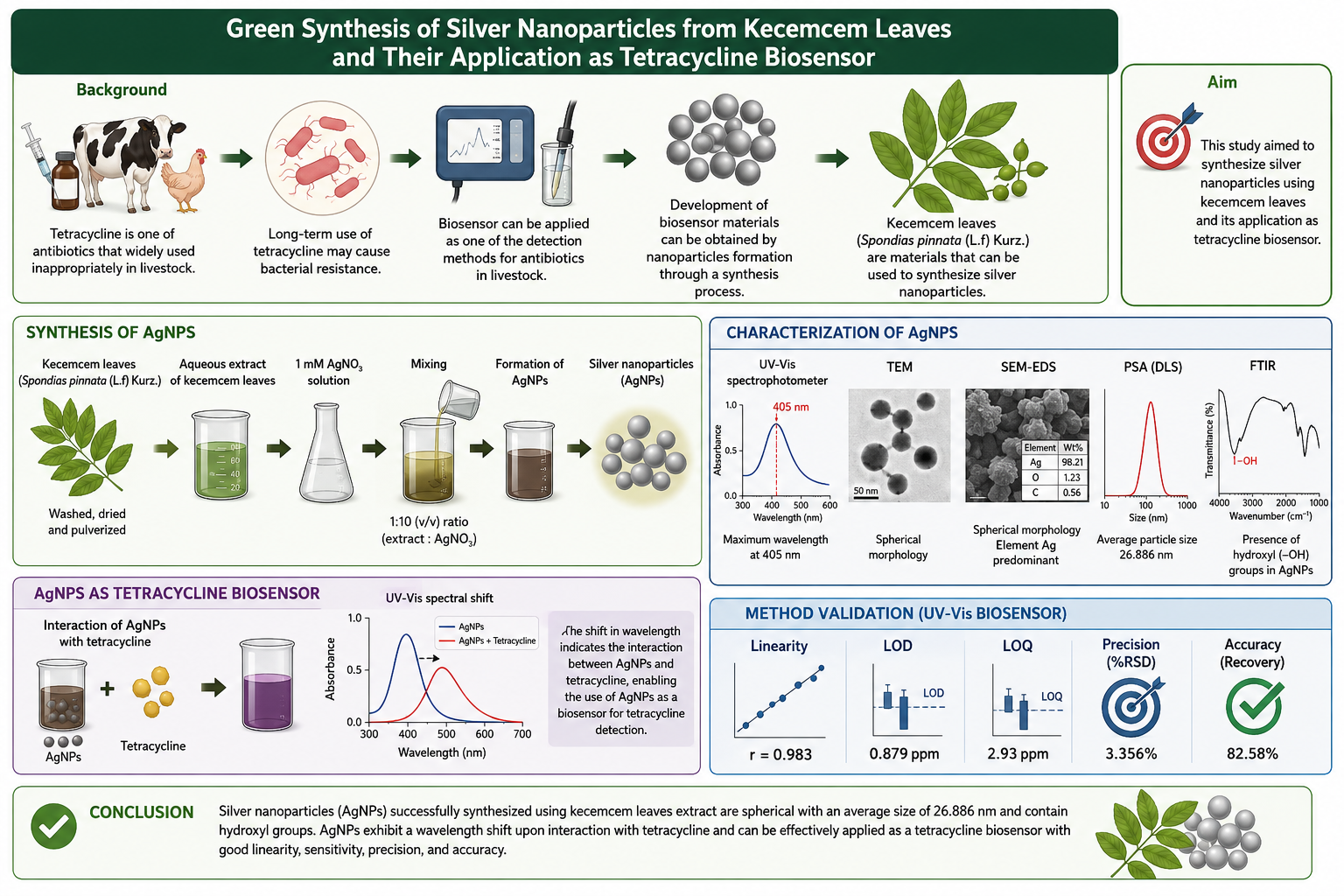
Tetracycline is one of antibiotics that widely used inappropriately in livestock. The long-term use of tetracycline may cause bacterial resistance. Biosensor can be applied as one of the detection methods for antibiotics in livestock. Development of biosensor materials can be obtained by nanoparticles formation through a synthesis process. Kecemcem leaves are materials that can be used to synthesize silver nanoparticles. This study aimed to synthesize silver nanoparticles using kecemcem leaves (Spondias pinnata (L.f) Kurz.) and its application as tetracycline biosensor. Aqueous extract of kecemcem leaves and 1 mM AgNO3 solution were combined in a 1:10 (v/v) ratio to create silver nanoparticles. The biosensor capability of silver nanoparticles was evaluated against tetracyclines after they were characterized using a UV-Vis spectrophotometer, particle size analyzer, scanning electron microscope-EDS, transmision electron microscope, and FTIR spectrophotometer. The maximum wavelength of the AgNPs scanning results on the UV-Vis spectrophotometer was in the 405 nm region. The results of characterization on TEM, SEM-EDS and PSA morphology of the formed AgNPs were spherical, the smallest particle size was 26.886 nm on average. In the characterization using FTIR there were found hydroxyl groups in AgNPs. The resulting nanoparticles could act as tetracycline biosensors, as evidenced by the shift in wavelength when AgNPs interacted with tetracycline. Detection of tetracycline was established based on the SPR technique. The brownish red color of the AgNPs solution turned to clear slightly reddish in the presence of tetracycline, accompanying the decrease in intensity of SPR band. Based on the method validation carried out, the linearity value was obtained in the form of r value of 0.983, LOD value of 0.879 ppm, and LOQ of 2.93 ppm, while a precision value of 3.356%, and an accuracy of 82.58%.
References
Araujo, Pedro. (2009). Key aspects of analytical method validation and linearity evaluation. Journal of Chromatography B, 877(23), 2224-2234
Badi’ah H., Seedeh F., Supriyanto G., Zaidan A. (2019). Synthesis of Silver Nanoparticles and the Development in Analysis Method. Iop Conference Series: Materials Science and Engineering, 217(1), 012005)
Bhaumik J., Thakur N.S., Aili P.K., Ghanghoriya A., Mittal A.K., Banerjee U.C. (2015). Bioinspired Nanotheranostic Agents: Synthesis, Surface Functionalization, And Antioxidant Potential. Acs Biomaterials Science & Engineering, 1, 382–392
Bruce P., Minkkinen P., Riekkola M.L. (1998). Practical method validation: Validation sufficient for an analysis method. Mikrochim Acta, 128, 93–106. https://doi.org/10.1007/BF01242196
Buncel E., Rajagopal S. (1990). Solvatochromism and Solvent Polarity Scales. Acc Chem Res, 23, 226-231
Deng H., Mcshan D., Zhang Y., Sinha S.S, Arslan Z., Ray P.C., Yu H. (2016). Mechanistic Study of the Synergistic Antibacterial Activity of Combined Silver Nanoparticles and Common Antibiotics. Environmental Science & Technology, 50(16), 8840-8848.
Food And Drug Administration. (2001). Guidance For Industry: Bioanalytical Method Validation. Rockville: Center For Veterinary Medicine
Ghodake G., Shinde S., Saratale R.G., Kadam A., Saratale G.D., Syed A., Kim D.Y. (2020). Silver nanoparticle probe for colorimetric detection of aminoglycoside antibiotics: picomolar-level sensitivity toward streptomycin in water, serum, and milk samples. Journal Of The Science Of Food And Agriculture, 100(2), 874-884
Gurunathan S., Kim J.H. (2016). Synthesis, toxicity, biocompatibility, and biomedical applications of graphene and graphene-related materials. Int. J. Nanomed, 11, 1927
Haes A.J., Van Duyne R.P. (2002). A nanoscale optical biosensor: sensitivity and selectivity of an approach based on the localized surface plasmon resonance spectroscopy of triangular silver nanoparticles. J. Am.Chem. Soc, 124, 10596-10604
Helmlinger J., Sengstock C., Groß-Heitfeld C., Mayer C., Schildhauer T.A., Köller M., Epple M. (2016). Silver nanoparticles with different size and shape: equal cytotoxicity, but different antibacterial effects. RSC Adv, 6, 18490-18501, DOI: 10.1039/C5RA27836H
Jalab J., Abdelwahed W., Kitaz A., Al-Kayali, R. (2021). Green synthesis of silver nanoparticles using aqueous extract of Acacia cyanophylla and its antibacterial activity. Heliyon, 7(9).
Jalalian S.H., Karimabadi N., Ramezani M., Abnous K., Taghdisi S.M. (2018). Electrochemical and optical aptamer-based sensors for detection of tetracyclines. Trends In Food Science & Technology, 73, 45-57
Kadian N., Raju K.S.R., Rashid M., Malik M.Y., Taneja I., Wahajuddin M. (2016). Comparative assessment of bioanalytical method validation guidelines for pharmaceutical industry. Journal of Pharmaceutical and Biomedical Analysis, 126, 83-97. https://doi.org/10.1016/j.jpba.2016.03.052
Kaur M., Gautam A., Guleria P., Singh K., Kumar V. (2022). Green synthesis of metal nanoparticles and their environmental applications. Current Opinion in Environmental Science & Health, 29, 100390
Kim Y.S., Kim J.H., Kim I.A., Lee S.J., Jurng J., Gu M.B. (2010). A novel colorimetric aptasensor using gold nanoparticle for a highly sensitive and specific detection of oxytetracycline. Biosens Bioelectron, 26(4),1644-9. http://doi10.1016/j.bios.2010.08.046
Malhotra B.D., Ali M.A. (2018). Nanomaterials In Biosensors: Fundamentals And Applications. http://doi10.1016/B978-0-323-44923-6.00001-7
Mittal A.K., J Bhaumik, S Kumar, UC Banerjee. (2014). Biosynthesis Of Silver Nanoparticles: Elucidation Of Prospective Mechanism And Therapeutic Potential. Journal Of Colloid And Interface Science, 415, 39–47.
Niraimathi K.L., Sudha V., Lavanya R., Brindha P. (2013). Biosynthesis of silver nanoparticles using Alternanthera sessilis (Linn.) extract and their antimicrobial, antioxidant activities. Colloids and Surfaces B: Biointerfaces,102, 288-291
Pazra D.F., Latif H., Basri C., Wibawan I.W.T. (2023). Tetrasiklin Resistance In Escherichia Coli Isolated From Pig Farm, Pig Slaugterhouse, And The Environment In Banten Province. Jurnal Kedokteran Hewan, 17(4), 121-126
Periasamy S., Jegadeesan U., Sundaramoorthi K., Rajeswari T., Tokala V.N.B., Bhattacharya S., Muthusamy S., Sankoh M., Nellore M.K. (2022). Comparative Analysis of Synthesis and Characterization of Silver Nanoparticles Extracted Using Leaf, Flower, and Bark of Hibiscus rosasinensis and Examine Its Antimicrobicidal Activity. Journal of Nanomaterials, 8123854
Purnamasari G.A.P.P., Lestari G.A.D., Cahyadi K.D., Esati N.K., Suprihatin I.E. (2021) Biosintesis Nanopartikel Perak Menggunakan Ekstrak Air Daun Cemmem (Spondias Pinnata (Lf) Kurz.) Dan Aktivitasnya Sebagai Antibakteri. Indonesian E-Journal Of Applied Chemistry, 9(2), 75-79
Restrepo C.V., Villa C.C. (2021). Synthesis of silver nanoparticles, influence of capping agents, and dependence on size and shape: A review. Environmental Nanotechnology, Monitoring & Management, 15, 100428
Sharma D., Kanchi S., Bisetty K. (2019). Biogenic synthesis of nanoparticles: A review. Arabian Journal of Chemistry, 12(8), 3576-3600
Singh R.K., Panigrahi B., Mishra S., Das B., Jayabalan R., Parhi P.K., Mandal D. (2018). pH triggered green synthesized silver nanoparticles toward selective colorimetric detection of kanamycin and hazardous sulfide ions. Molliq, http://doi:10.1016/j.molliq.2018.08.056
Singh B., Bhat A., Dutta L., Pati K.R., Korpan Y., Dahiya I. (2023). Electrochemical Biosensors for the Detection of Antibiotics in Milk: Recent Trends and Future Perspectives. Biosensors, 13, 867. https://doi.org/10.3390/ bios13090867
Suchithta M.R., Bhuvaneswari S., Sampathkumar P., Dineshkumar R., Chithradevi K., Beevi, M., Madhumitha R., Kavisri M. (2021). In vitro study of antioxidant, antidiabetic and antiurolithiatic activity of synthesized silver nanoparticles using stem bark extracts of Hybanthus enneaspermus. Biocatalysis and Agricultural Biotechnology, 38, 102219
Sujarwo W., Saraswaty V., Keim A.P., Caneva G., Tofani D. (2017). Ethnobotanical uses of ‘cemcem’ (Spondias pinnata (L.F.) kurz; anacardiaceae) leaves in bali (Indonesia) and its antioxidant activity. Pharmacologyonline, 1, 113-123.
Sulaiman I.S., Basri M., Fard H.R.M, Chee W.J., Ashari S.E., Ismail M. (2017) Effects of temperature, time, and solvent ratio on the extraction of phenolic compounds and the anti-radical activity of Clinacanthus nutans Lindau leaves by response surface methodology. Chemistry Central Journal, 11(1), 1-11.
Swathi S., Lakshman K. (2022) Phytopharmacological and Biological Exertion of Spondias pinnata: (A Review). Oriental Journal Of Chemistry, 38(2), 271
Widiasih D.A., Drastini Y., Yudhabuntara D., Maya F.L.R.D., Sivalingham P.L., Susetya H., Sumiarto. (2019) Detection of antibiotic residues in chicken meat and eggs from traditional markets at Yogyakarta City using bioassay method. B. Acta Veterinaria Indonesiana, 1-6.
Xu L., Zhang H., Xiong P., Zhu Q., Liao C., Jiang G (2021). Occurrence, fate, and risk assessment of typical tetracycline antibiotics in the aquatic environment: A review. Science Of The Total Environment, 753.
Downloads
Published
Issue
Section
License
Copyright (c) 2026 Malaysian Journal of Science (MJS)

This work is licensed under a Creative Commons Attribution-NonCommercial 4.0 International License.
Transfer of Copyrights
- In the event of publication of the manuscript entitled [INSERT MANUSCRIPT TITLE AND REF NO.] in the Malaysian Journal of Science, I hereby transfer copyrights of the manuscript title, abstract and contents to the Malaysian Journal of Science and the Faculty of Science, University of Malaya (as the publisher) for the full legal term of copyright and any renewals thereof throughout the world in any format, and any media for communication.
Conditions of Publication
- I hereby state that this manuscript to be published is an original work, unpublished in any form prior and I have obtained the necessary permission for the reproduction (or am the owner) of any images, illustrations, tables, charts, figures, maps, photographs and other visual materials of whom the copyrights is owned by a third party.
- This manuscript contains no statements that are contradictory to the relevant local and international laws or that infringes on the rights of others.
- I agree to indemnify the Malaysian Journal of Science and the Faculty of Science, University of Malaya (as the publisher) in the event of any claims that arise in regards to the above conditions and assume full liability on the published manuscript.
Reviewer’s Responsibilities
- Reviewers must treat the manuscripts received for reviewing process as confidential. It must not be shown or discussed with others without the authorization from the editor of MJS.
- Reviewers assigned must not have conflicts of interest with respect to the original work, the authors of the article or the research funding.
- Reviewers should judge or evaluate the manuscripts objective as possible. The feedback from the reviewers should be express clearly with supporting arguments.
- If the assigned reviewer considers themselves not able to complete the review of the manuscript, they must communicate with the editor, so that the manuscript could be sent to another suitable reviewer.
Copyright: Rights of the Author(s)
- Effective 2007, it will become the policy of the Malaysian Journal of Science (published by the Faculty of Science, University of Malaya) to obtain copyrights of all manuscripts published. This is to facilitate:
- Protection against copyright infringement of the manuscript through copyright breaches or piracy.
- Timely handling of reproduction requests from authorized third parties that are addressed directly to the Faculty of Science, University of Malaya.
- As the author, you may publish the fore-mentioned manuscript, whole or any part thereof, provided acknowledgement regarding copyright notice and reference to first publication in the Malaysian Journal of Science and Faculty of Science, University of Malaya (as the publishers) are given. You may produce copies of your manuscript, whole or any part thereof, for teaching purposes or to be provided, on individual basis, to fellow researchers.
- You may include the fore-mentioned manuscript, whole or any part thereof, electronically on a secure network at your affiliated institution, provided acknowledgement regarding copyright notice and reference to first publication in the Malaysian Journal of Science and Faculty of Science, University of Malaya (as the publishers) are given.
- You may include the fore-mentioned manuscript, whole or any part thereof, on the World Wide Web, provided acknowledgement regarding copyright notice and reference to first publication in the Malaysian Journal of Science and Faculty of Science, University of Malaya (as the publishers) are given.
- In the event that your manuscript, whole or any part thereof, has been requested to be reproduced, for any purpose or in any form approved by the Malaysian Journal of Science and Faculty of Science, University of Malaya (as the publishers), you will be informed. It is requested that any changes to your contact details (especially e-mail addresses) are made known.
Copyright: Role and responsibility of the Author(s)
- In the event of the manuscript to be published in the Malaysian Journal of Science contains materials copyrighted to others prior, it is the responsibility of current author(s) to obtain written permission from the copyright owner or owners.
- This written permission should be submitted with the proof-copy of the manuscript to be published in the Malaysian Journal of Science
Licensing Policy
Malaysian Journal of Science is an open-access journal that follows the Creative Commons Attribution-Non-commercial 4.0 International License (CC BY-NC 4.0)
CC BY – NC 4.0: Under this licence, the reusers to distribute, remix, alter, and build upon the content in any media or format for non-commercial purposes only, as long as proper acknowledgement is given to the authors of the original work. Please take the time to read the whole licence agreement (https://creativecommons.org/licenses/by-nc/4.0/legalcode ).