Direct Numerical Algorithm as First, Second and Third-Order IVPS Solver
DOI:
https://doi.org/10.22452/Keywords:
block method, consistency, convergence, collocation, zero-stabilityAbstract
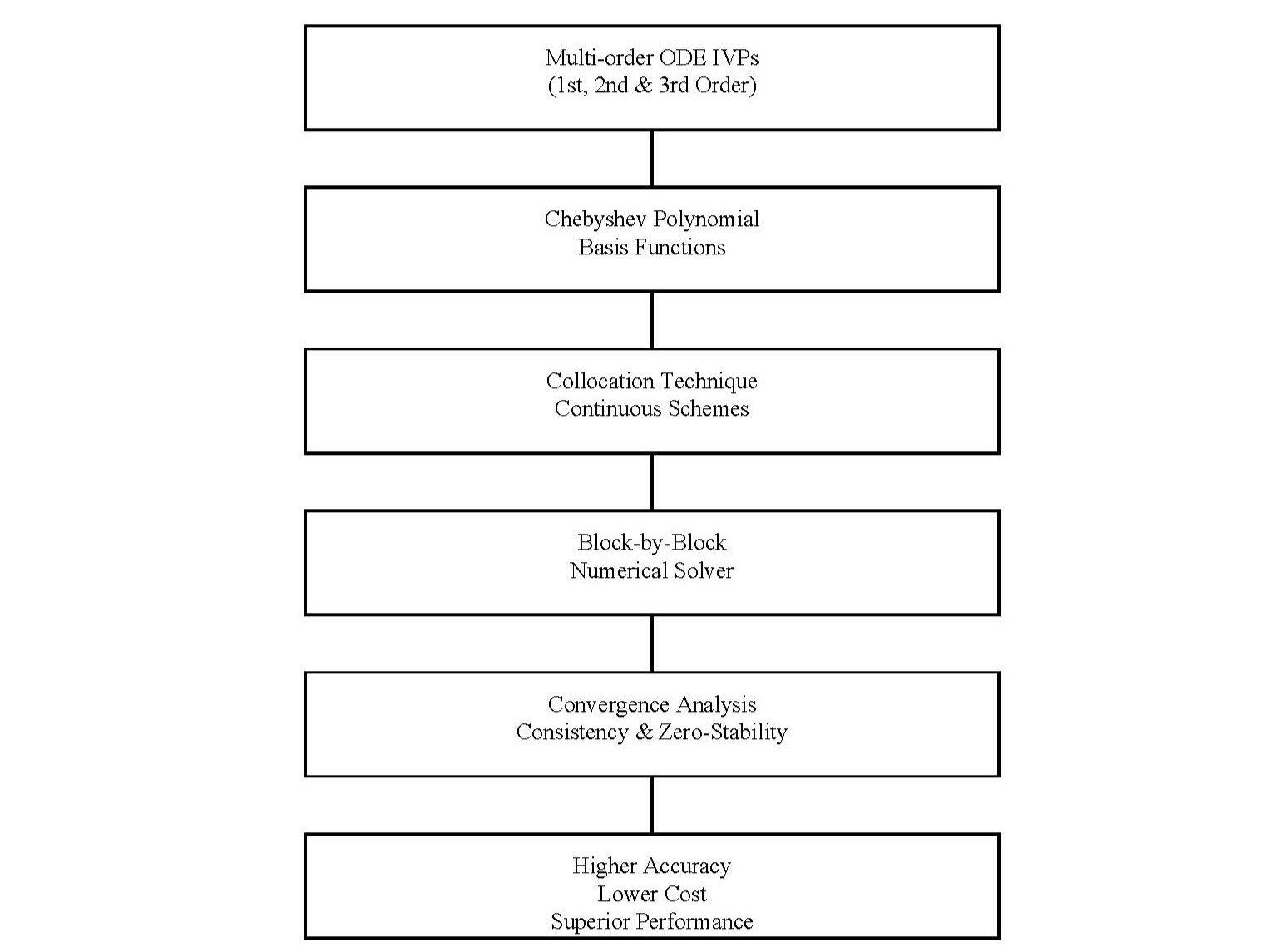
This paper presents a novel numerical model for accurately integrating initial value problems of multi-order ordinary differential equations (ODEs) of first, second, and third orders. Chebyshev polynomials are employed as the basis functions, and the collocation technique is used to develop continuous schemes that are evaluated at selected points to formulate the proposed multi-order ODE solver, which is applied in a block-by-block manner. The convergence analysis is carried out to establish the zero-stability and consistency of the method. Comparisons with existing methods show the superior performance of the proposed method. The results indicate its ability to solve multi-order ODEs more effectively while reducing the computational cost. This work represents a significant advance in numerical integration for ODEs, providing improved accuracy and efficiency in solving a wide range of multi-order ODE problems.
References
Adeyefa, E.O., Olajide, O.A., Akinola, L.S., Abolarin, O.E., Ibrahim, A.A. & Haruna, Y. (2020), On direct integration of second and third order ordinary differential equations, J. Eng. Appl. Sci. 15 1972-1976.
Ajileye, G., Amoo, S.A. & Ogwumu, O.D. (2018), Hybrid block method algorithms for solution of first order initial value problems in ordinary differential equation, J. Appl. Comput. Math. 7 1-4. https://doi.org/10.4172/2168-9679.1000390.
Allogmany, R. & Ismail F. (2020), Implicit three-point block numerical algorithm for solving third order initial value problem directly with applications, Math. 8 1771. doi:10.3390/math8101771.
Awoyemi, D.O. (1999), A class of continuous linear multistep methods for general second-order initial value problems in ordinary differential equations, Intern. J. Comput. Math. 72 29-37.
Dahlquist, G. (1979), Some properties of linear multistep and one leg method for ordinary differential equations. Department of comput. sci. Royal institute of tech., Stockholm
Fatunla, S.O. (1991), Block method for second-order initial value problem, Intern. J. Compt. Math. 41 55-63.
Folaranmi, R.O. Adeniyi, R.B. & Adeyefa, E.O. (2016), An orthogonal based self-starting numerical integrator for third order IVPs in ordinary differential equations, The Pacific J. Sci. Tech. 17 73 – 86.
Henrichi, P. (1962), Discrete variable methods in ordinary differential equations, {it John Wiley and Sons}, New York
Hussain, K.A. Ismail, F. Senu, N. & Rabiei, F. (2017), Fourth-order improved runge–kutta method for directly solving special third order ordinary differential equations, Iranian J. Sci. Tech. 41 429-437. DOI 10.1007/s40995-017-0258-1
Ismail, F. Ken, Y.L. & Othman, M. (2009), Explicit and implicit 3-point block methods for solving special second order ordinary differential equations directly, Intern. J. Math. Analy. 3 239-254.
Jator, S.N. (2010), Solving second order initial value problems by a hybrid multistep method without predictors, Appl. Math. Comput. 217 4036–4046
Kayode, S.J. & Adegboro, J.O. (2018), Predictor-corrector linear multistep method for direct solution of initial value problems of second order ordinary differential equations, Asian J. Phys. Chem. Sci. 6 1-9.
Kuboye, J.O. (2015), Block methods for direct solution of higher-order ordinary differential equations using interpolation and collocation approach, Ph.D. thesis, Universiti Utara Malaysia.. http://etd.uum.edu.my/id/eprint/5789.
Lambert, J.D. (1991), Numerical methods for ordinary differential systems, John Willey and Sons New York.
Lambert, J.D. (1973), Computational methods for ordinary differential equations, John Willey and Sons New York.
Mohammed, U. & Adeniyi, R.B. (2014), Derivation of five-step block hybrid backward differential formulas through the continuous multi-step collocation for solving second order differential equation, Pacific J. Sci. Tech. 15 89 – 95.
Olabode, B.T. (2009), An accurate scheme by block method for the third-order ordinary differential equation, Pacific J. Sci. Tech. 10 136 – 142.
Ramos, H., Mehta, S. Vigo-Aguiar, J. A unified approach for the development of k-Step block Falkner-type methods for solving general second-order initial-value problems in ordinary differential equations, J. Comput. Appl. Math. Article in Press.
Ramos, H.& Rufai, M.A. (2021) An adaptive one-point second derivative lobatto-type hybrid method for solving efficiently differential systems, Intern. J. Comput. Math. 1-19. DOI: 10.1080/00207160.2021.1999429.
Downloads
Published
Issue
Section
License
Copyright (c) 2026 Malaysian Journal of Science (MJS)

This work is licensed under a Creative Commons Attribution-NonCommercial 4.0 International License.
Transfer of Copyrights
- In the event of publication of the manuscript entitled [INSERT MANUSCRIPT TITLE AND REF NO.] in the Malaysian Journal of Science, I hereby transfer copyrights of the manuscript title, abstract and contents to the Malaysian Journal of Science and the Faculty of Science, University of Malaya (as the publisher) for the full legal term of copyright and any renewals thereof throughout the world in any format, and any media for communication.
Conditions of Publication
- I hereby state that this manuscript to be published is an original work, unpublished in any form prior and I have obtained the necessary permission for the reproduction (or am the owner) of any images, illustrations, tables, charts, figures, maps, photographs and other visual materials of whom the copyrights is owned by a third party.
- This manuscript contains no statements that are contradictory to the relevant local and international laws or that infringes on the rights of others.
- I agree to indemnify the Malaysian Journal of Science and the Faculty of Science, University of Malaya (as the publisher) in the event of any claims that arise in regards to the above conditions and assume full liability on the published manuscript.
Reviewer’s Responsibilities
- Reviewers must treat the manuscripts received for reviewing process as confidential. It must not be shown or discussed with others without the authorization from the editor of MJS.
- Reviewers assigned must not have conflicts of interest with respect to the original work, the authors of the article or the research funding.
- Reviewers should judge or evaluate the manuscripts objective as possible. The feedback from the reviewers should be express clearly with supporting arguments.
- If the assigned reviewer considers themselves not able to complete the review of the manuscript, they must communicate with the editor, so that the manuscript could be sent to another suitable reviewer.
Copyright: Rights of the Author(s)
- Effective 2007, it will become the policy of the Malaysian Journal of Science (published by the Faculty of Science, University of Malaya) to obtain copyrights of all manuscripts published. This is to facilitate:
- Protection against copyright infringement of the manuscript through copyright breaches or piracy.
- Timely handling of reproduction requests from authorized third parties that are addressed directly to the Faculty of Science, University of Malaya.
- As the author, you may publish the fore-mentioned manuscript, whole or any part thereof, provided acknowledgement regarding copyright notice and reference to first publication in the Malaysian Journal of Science and Faculty of Science, University of Malaya (as the publishers) are given. You may produce copies of your manuscript, whole or any part thereof, for teaching purposes or to be provided, on individual basis, to fellow researchers.
- You may include the fore-mentioned manuscript, whole or any part thereof, electronically on a secure network at your affiliated institution, provided acknowledgement regarding copyright notice and reference to first publication in the Malaysian Journal of Science and Faculty of Science, University of Malaya (as the publishers) are given.
- You may include the fore-mentioned manuscript, whole or any part thereof, on the World Wide Web, provided acknowledgement regarding copyright notice and reference to first publication in the Malaysian Journal of Science and Faculty of Science, University of Malaya (as the publishers) are given.
- In the event that your manuscript, whole or any part thereof, has been requested to be reproduced, for any purpose or in any form approved by the Malaysian Journal of Science and Faculty of Science, University of Malaya (as the publishers), you will be informed. It is requested that any changes to your contact details (especially e-mail addresses) are made known.
Copyright: Role and responsibility of the Author(s)
- In the event of the manuscript to be published in the Malaysian Journal of Science contains materials copyrighted to others prior, it is the responsibility of current author(s) to obtain written permission from the copyright owner or owners.
- This written permission should be submitted with the proof-copy of the manuscript to be published in the Malaysian Journal of Science
Licensing Policy
Malaysian Journal of Science is an open-access journal that follows the Creative Commons Attribution-Non-commercial 4.0 International License (CC BY-NC 4.0)
CC BY – NC 4.0: Under this licence, the reusers to distribute, remix, alter, and build upon the content in any media or format for non-commercial purposes only, as long as proper acknowledgement is given to the authors of the original work. Please take the time to read the whole licence agreement (https://creativecommons.org/licenses/by-nc/4.0/legalcode ).