Utilization of Landsat-8 Image Classification Results with the Random Forest Algorithm to Determine Groundwater Recharge Areas (Case Study: Singgahan and Montong Districts, Tuban Regency)
DOI:
https://doi.org/10.22452/Keywords:
Landsat-8, image classification, random forest, groundwater recharge areaAbstract
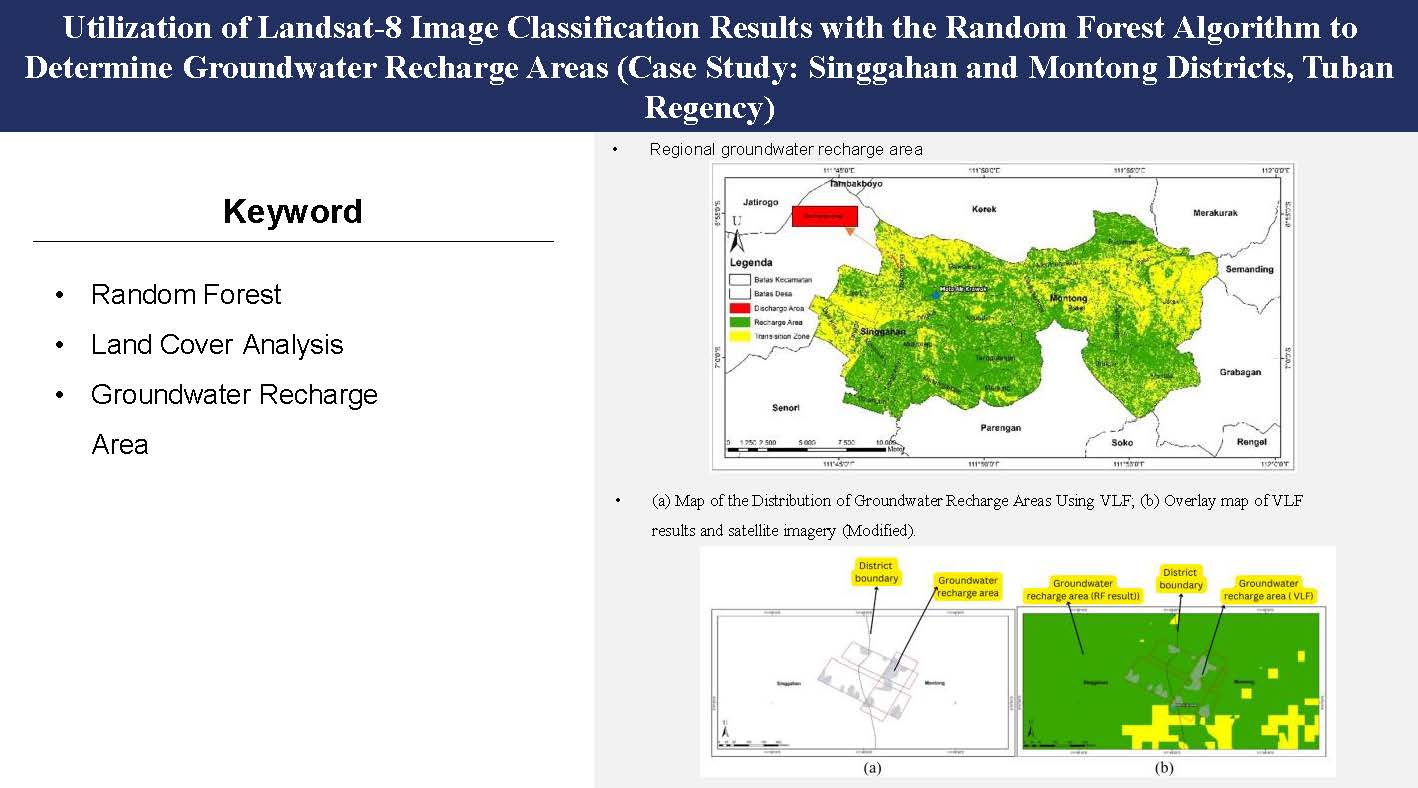
Groundwater is highly beneficial for society, and fulfills essential daily living needs and activities. With increasing population growth, groundwater use has increased, necessitating the creation of a map depicting the distribution of groundwater recharge areas. This map is expected to aid the government and communities to identify all the locations of groundwater distribution and ensure the sustainability of groundwater discharge in the area. The method employed involves using Landsat-8 image classification results to produce land cover maps of the study area. Land cover data processing was conducted using the open platform Google Earth Engine with a Random Forest algorithm. The classification of Landsat-8 images resulted in six land cover classes with an overall accuracy of 99.60% and a Kappa value of 0.994. Overlay and weighting were performed using parameters that determine the distribution of groundwater recharge areas. The parameters utilized included supporting data such as rainfall, soil type, and slope, which were obtained from DEMNAS data. The overlay and weighting results indicate that the potential recharge area covered 13,010.33 hectares (59.21%), the transition zone covered 8,935.27 hectares (40.66%), and the discharge area covered 28.64 hectares (0.13%).
References
Adugna T., Xu W., & Fan, J. (2022). Comparison of Random Forest and Support Vector Machine Classifiers for Regional Land Cover Mapping Using Coarse Resolution FY-3C Images. Remote Sensing, 14(3), 1–22. https://doi.org/10.3390/rs14030574
Arikan D. (2023). Land cover generation using random forest algorithm on Google Earth Engine platform. Proceedings of the International Turkic World Congress On Science and Engineering, Bishkek Kyrgyztan.
Badan Meteorologi, Klimatologi, dan Geofisika. (2021). Badan Meteorologi, Klimatologi, dan Geofisika. Retrieved from https://www.bmkg.go.id/
Forestier H. (2007). Ribuan Gunung, Ribuan Alat Batu: Prasejarah Song Keplek, Gunung Sewu, Jawa Timur (No. 7). Kepustakaan Populer Gramedia.
Lachaud A., Adam M., & Mišković I. (2023). Comparative Study of Random Forest and Support Vector Machine Algorithms in Mineral Prospectivity Mapping with Limited Training Data. Minerals, 13(8). https://doi.org/10.3390/min13081073
Melillos G., & Hadjimitsis D. (2020). Using simple ratio (SR) vegetation index to detect deep man-made infrastructures in Cyprus. https://doi.org/10.1117/12.2557893
Mypatriot.id. (2017). Peta cekungan air tanah Indonesia tahun 2017. Retrieved from https://mypatriot.id/patgtl/datapubliclist
Peraturan Menteri Kehutanan RI. (2009). P.32/MENHUT-II/2009 tentang Tata Cara Penyusunan Teknik Rehabilitasi Hutan dan Lahan Daerah Aliran Sungai (RTkRHLDAS). Jakarta: Menteri Kehutanan RI.
Purwanto M. S., Haq, Z. M., Fachyesi, A. S., Dewi, S., & Amalina, S. (2022). Penentuan recharge area pada Kabupaten Tanah Datar menggunakan citra Landsat-8 dan sistem informasi geografis (SIG). Journal Geosaintek, 8(3), 242–248.
Purwanto M. S., Susilo, A., Bahri, A. S., Naba, A., Sari, U. I., & Almais, A. T. W. (2024). Mapping underground river flows in karst areas with the VLF-EM method (Case study of the Krawak Region, Singgahan Tuban). IOP Conference Series: Earth and Environmental Science, 1307(1), Article 012005. https://doi.org/10.1088/1755-1315/1307/1/012005
Ramji Satyaji Rao Y. (2022). Mapping and Change Detection of Water Bodies in the Godavari Delta using Geospatial Technology. ADBU-Journal of Engineering Technology, 11(1), 1–6. www.earthexplorer.usgs.gov
Shin N., Saitoh T. M., Takeuchi Y., Miura T., Aiba M., Kurokawa H., Onoda Y., Ichii K., Nasahara K. N., Suzuki R., Nakashizuka T., & Muraoka H. (2022). Review: Monitoring of land cover changes and plant phenology by remote-sensing in East Asia. Ecological Research, 38(1), 111–133. https://doi.org/10.1111/1440-1703.12371
Fiantis D. (2017). Morfologi dan Klasifikasi Tanah. Padang. Lembaga Pengembangan Teknologi Informasi dan Komunikasi (LPTIK) Universitas Andalas.
Undang-undang Nomor 7 Tahun 2004 tentang Sumber Daya Air. Jakarta, Indonesia: Pemerintah Pusat.
Vasileva T. (2019). An assessment of potential groundwater recharge zones in Bulgaria. Geologica Balcanica, 48(1), 43–61. https://doi.org/10.52321/geolbalc.48.1.43
Wang S., & Fu G. (2023). Modelling soil moisture using climate data and normalized difference vegetation index based on nine algorithms in alpine grasslands. Frontiers in Environmental Science, 11(February), 1–12. https://doi.org/10.3389/fenvs.2023.1130448
Wiggers M. J., Nuarsa I. W., & Putra I. N. (2020). Monitoring perubahan penggunaan lahan pesisir di Kecamatan Batu Layar, Kabupaten Lombok Barat pada tahun 2002 dan 2019. Journal of Marine Research and Technology, 3(2), 68-74.
Zulfajri, Danoedoro P., & Murti S. H. (2021). Klasifikasi tutupan lahan data Landsat-8 Oli menggunakan metode Random Forest. Journal Penginderaan Jauh Indonesia, 03(01), 1–7. http://journal.mapin.or.id/index.php/jpji/issue/archive
Downloads
Published
Issue
Section
License
Copyright (c) 2026 Malaysian Journal of Science (MJS)

This work is licensed under a Creative Commons Attribution-NonCommercial 4.0 International License.
Transfer of Copyrights
- In the event of publication of the manuscript entitled [INSERT MANUSCRIPT TITLE AND REF NO.] in the Malaysian Journal of Science, I hereby transfer copyrights of the manuscript title, abstract and contents to the Malaysian Journal of Science and the Faculty of Science, University of Malaya (as the publisher) for the full legal term of copyright and any renewals thereof throughout the world in any format, and any media for communication.
Conditions of Publication
- I hereby state that this manuscript to be published is an original work, unpublished in any form prior and I have obtained the necessary permission for the reproduction (or am the owner) of any images, illustrations, tables, charts, figures, maps, photographs and other visual materials of whom the copyrights is owned by a third party.
- This manuscript contains no statements that are contradictory to the relevant local and international laws or that infringes on the rights of others.
- I agree to indemnify the Malaysian Journal of Science and the Faculty of Science, University of Malaya (as the publisher) in the event of any claims that arise in regards to the above conditions and assume full liability on the published manuscript.
Reviewer’s Responsibilities
- Reviewers must treat the manuscripts received for reviewing process as confidential. It must not be shown or discussed with others without the authorization from the editor of MJS.
- Reviewers assigned must not have conflicts of interest with respect to the original work, the authors of the article or the research funding.
- Reviewers should judge or evaluate the manuscripts objective as possible. The feedback from the reviewers should be express clearly with supporting arguments.
- If the assigned reviewer considers themselves not able to complete the review of the manuscript, they must communicate with the editor, so that the manuscript could be sent to another suitable reviewer.
Copyright: Rights of the Author(s)
- Effective 2007, it will become the policy of the Malaysian Journal of Science (published by the Faculty of Science, University of Malaya) to obtain copyrights of all manuscripts published. This is to facilitate:
- Protection against copyright infringement of the manuscript through copyright breaches or piracy.
- Timely handling of reproduction requests from authorized third parties that are addressed directly to the Faculty of Science, University of Malaya.
- As the author, you may publish the fore-mentioned manuscript, whole or any part thereof, provided acknowledgement regarding copyright notice and reference to first publication in the Malaysian Journal of Science and Faculty of Science, University of Malaya (as the publishers) are given. You may produce copies of your manuscript, whole or any part thereof, for teaching purposes or to be provided, on individual basis, to fellow researchers.
- You may include the fore-mentioned manuscript, whole or any part thereof, electronically on a secure network at your affiliated institution, provided acknowledgement regarding copyright notice and reference to first publication in the Malaysian Journal of Science and Faculty of Science, University of Malaya (as the publishers) are given.
- You may include the fore-mentioned manuscript, whole or any part thereof, on the World Wide Web, provided acknowledgement regarding copyright notice and reference to first publication in the Malaysian Journal of Science and Faculty of Science, University of Malaya (as the publishers) are given.
- In the event that your manuscript, whole or any part thereof, has been requested to be reproduced, for any purpose or in any form approved by the Malaysian Journal of Science and Faculty of Science, University of Malaya (as the publishers), you will be informed. It is requested that any changes to your contact details (especially e-mail addresses) are made known.
Copyright: Role and responsibility of the Author(s)
- In the event of the manuscript to be published in the Malaysian Journal of Science contains materials copyrighted to others prior, it is the responsibility of current author(s) to obtain written permission from the copyright owner or owners.
- This written permission should be submitted with the proof-copy of the manuscript to be published in the Malaysian Journal of Science
Licensing Policy
Malaysian Journal of Science is an open-access journal that follows the Creative Commons Attribution-Non-commercial 4.0 International License (CC BY-NC 4.0)
CC BY – NC 4.0: Under this licence, the reusers to distribute, remix, alter, and build upon the content in any media or format for non-commercial purposes only, as long as proper acknowledgement is given to the authors of the original work. Please take the time to read the whole licence agreement (https://creativecommons.org/licenses/by-nc/4.0/legalcode ).