Physicochemical Properties of Potassium Carbonate-Ethylene Glycol Mixtures at Different Molar Ratios and Temperatures
DOI:
https://doi.org/10.22452/Keywords:
potassium carbonate-ethylene glycol, density, viscosity, ionic conductivity, Fourier Transform Infrared SpectroscopyAbstract
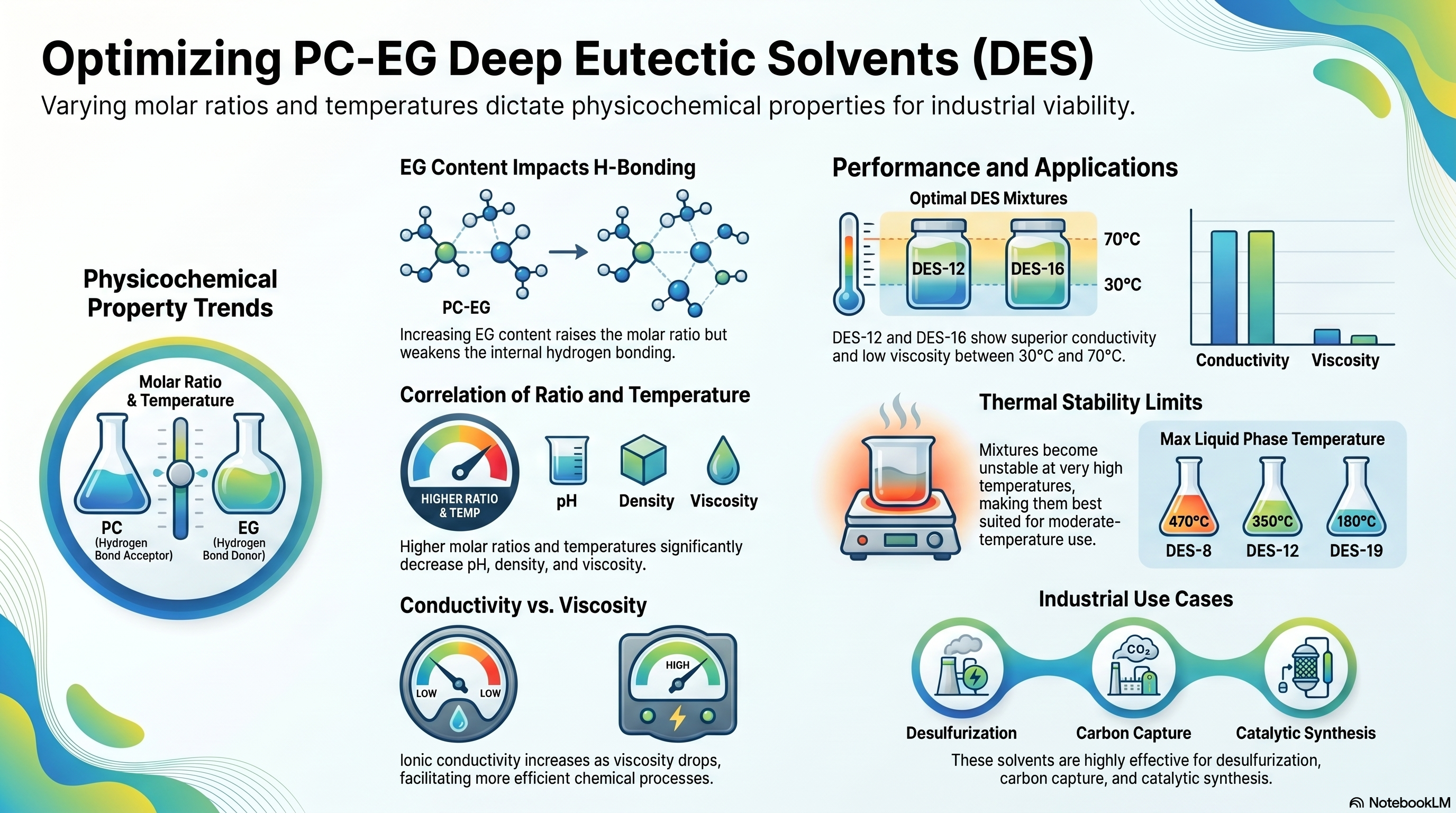
Deep Eutectic Solvents (DESs) are highly effective and environmentally benign for various industrial applications, including extraction, catalysis, and synthesis. The success of DESs relies on the types of hydrogen bond acceptor (HBA) and hydrogen bond donor (HBD), as well as the molar ratios and temperatures used during the process. The study investigated the solubility of PC-EG mixture at various molar ratios to determine suitable molar ratios for achieving a eutectic mixture. Then, the physicochemical properties of the PC-EG mixtures, such as phase behavior, H-bonding, density, viscosity, conductivity and thermal stability across different molar ratios and temperatures, were analyzed. Differential Scanning Calorimetry (DSC) analysis confirmed that all mixtures were DESs, as their freezing points were lower than those of their individual components. The solid-liquid phase diagram showed that DES-8, DES-12, DES-16, and DES-19 remained in the liquid phase at temperatures of 470°C, 350°C, 220°C and 180°C, respectively. Meanwhile, FTIR analyses verified the presence of H-bonding within the DESs, but DES-19 showed minimal interaction between PC and EG. The results indicated that adding more EG content raised the molar ratio but weakened H-bonding. Similarly, increasing the molar ratio and temperature decreased the pH, density, and viscosity of the DESs, while ionic conductivity increased. Thermal analysis indicated the thermal instability of the mixtures at very high temperatures, suggesting their suitability for use at moderate temperatures. The result found that DES-12 and DES-16 had low viscosity, with strong H-bonding and excellent ionic conductivity within 30°C–40°C and 50°C–70°C. The findings of this study provide significant guidance on the effective use of PC-EG at appropriate molar ratios and temperatures to enhance desulfurization, carbon capture, and various industrial applications to achieve optimal results.
References
Achkar, T., E., Hélène G., & Sophie F. (2021) Basics and Properties of Deep Eutectic Solvents: A Review. Environmental Chemistry Letters 19, 3397–3408.
Chen, Y., & Mu, T. (2021) Revisiting Greenness of Ionic Liquids and Deep Eutectic Solvents. Green Chemical Engineering 2(2): 174-186. https://doi.org/10.1016/j.gce.2021.01.004
Ghaedi, H., Muhammad A., Suriati S., Sintayehu M., Ghulam M., & Saleem N., K. (2018) Thermal Stability Analysis, Experimental Conductivity and pH of Phosphonium-Based Deep Eutectic Solvents and their Prediction by a New Empirical Equation. Chemical Thermodynamics 116, 50–60. https://doi.org/10.1016/j.jct.2017.08.029.
Ghaedi, H., Payam K., Ming Z., Peter T., C., Edward J., A., & Paul, S., F. (2022) Potassium Carbonate-Based Ternary Transition Temperature Mixture (Deep Eutectic Analogues) for CO2 Absorption: Characterizations and DFT Analysis. Frontiers of Environmental Science and Engineering 16(7). https://doi.org/10.1007/s11783-021-1500-9.
Hansen, B., B., Stephanie, S., Brian, C., Derrick, P., Yong, Z., Jeffrey, M., K., Alexandre, H., et al. (2021) Deep Eutectic Solvents: A Review of Fundamentals and Applications. Chemical Reviews American Chemical Society 121(3): 1232–1285.
Ibrahim, R., K., Hayyan, M., M., A., AlSaadi, I., S., Hayyan, A., & Hashim, M. A. (2019) Physical Properties of Ethylene Glycol-Based Deep Eutectic Solvents. Molecular Liquids 276, 794–800. https://doi.org/10.1016/j.molliq.2018.12.032.
Jagirani, M., S., & Soylak, M. (2022) Deep Eutectic Solvents-Based Adsorbents in Environmental Analysis. TrAC Trends in Analytical Chemistry 157, 116762.
Jibril, B., Mjalli, F., Naser, J., & Zaharaddeen G. (2014) New Tetrapropylammonium Bromide-Based Deep Eutectic Solvents: Synthesis and Characterizations. Molecular Liquids 199, 462–469. https://doi.org/10.1016/j.molliq.2014.08.004.
Khan, N., & Srivastava, V., C. (2022) Extractive Desulfurization Using Ethylene Glycol and Glycerol-Based Deep Eutectic Solvents: Engineering Aspects and Intensification Using Ultrasound. Chemical Engineering and Processing - Process Intensification 180. https://doi.org/10.1016/j.cep.2022.108973.
Lima, F., Luis, C., B., Armando, J., D., S., & Isabel, M., M. (2021) Deep Desulfurization of Fuels: Are Deep Eutectic Solvents the Alternative for Ionic Liquids? Fuel 293. 120297.
Maslova, O., Olga S., Argam A., Sergey L., Alexander A., & Elena E. (2021) Nanocatalysts for Oxidative Desulfurization of Liquid Fuel: Modern Solutions and the Perspectives of Application in Hybrid Chemical‐biocatalytic Processes. Catalysts 1(9):1131.
Mjalli, F., S., Jamil, N., Baba J., Safiya S. A., & Zaharaddeen, S., G. (2014) Ionic Liquids Analogues Based on Potassium Carbonate. Thermochimica Acta 575, 135–43.
Naser, J., Mjalli, F., Jibril, B., Al-Hatmi, S., & Gano, Z. (2013) Potassium Carbonate as a Salt for Deep Eutectic Solvents. Chemical Engineering and Applications, 4(3): 114–18.
Saeed, U., Asad, U., K., Asim, L., K., Mazhar, A., G., & Muhammad, R., B. (2022) Separation of Carbon Dioxide by Potassium Carbonate Based Supported Deep Eutectic Liquid Membranes: Influence of Hydrogen Bond Donor. Membrane Science and Research, 8(1): https://doi.org/10.22079/JMSR.2021.526587.1460.
Talip, R., A., A., Yahya, W., Z., N., & Bustam, M., A. (2021) Viscosity and Ionic Conductivity of Imidazolium Based Ionic Liquids Bearing Triiodide Anion. E3S Web of Conferences 287. 02015 https://doi.org/10.1051/e3sconf/202128702015.
Umar, A., Mamoona M., Maida M., Rida S., Muhammad, A., R., Gokul, R., S., Aswa F., & Saeed, M. (2020) Properties and Green Applications Based Review on Highly Efficient Deep Eutectic Solvents. Egyptian Journal of Chemistry 63(1): 59–69.
Wang, B., J., Cheng, D., Wang, X., Liu, Q., M., Zhang, Z., J., An, X. L., & Li, M. (2020) Study on the Desulfurization and Regeneration Performance of Functional Deep Eutectic Solvents. ACS Omega 5(25): 15353–15361 https://doi.org/10.1021/acsomega.0c01467.
Wang, H., Liu, S., Zhao Y., Wang, J., & Yu, Z. (2019) Insights into the Hydrogen Bond Interactions in Deep Eutectic Solvents Composed of Choline Chloride and Polyols. ACS Sustainable Chemistry and Engineering 7(8): 7760–67.
Yang, D., Zhang, S., Jiang, D., E., & Dai, S. (2018) SO2 Absorption in EmimCl-TEG Deep Eutectic Solvents. Physical Chemistry Chemical Physics 20(22): 15168–73.
Zeng, P., Wu, D., Wang, T., Liu, P., & Jia, D. (2024) Redefine the Existence Form and Function of Water in Potassium Carbonate-Based Deep Eutectic Electrolyte. Fuel 357. https://doi.org/10.1016/j.fuel.2023.129738.
Downloads
Published
Issue
Section
License
Copyright (c) 2026 Malaysian Journal of Science (MJS)

This work is licensed under a Creative Commons Attribution-NonCommercial 4.0 International License.
Transfer of Copyrights
- In the event of publication of the manuscript entitled [INSERT MANUSCRIPT TITLE AND REF NO.] in the Malaysian Journal of Science, I hereby transfer copyrights of the manuscript title, abstract and contents to the Malaysian Journal of Science and the Faculty of Science, University of Malaya (as the publisher) for the full legal term of copyright and any renewals thereof throughout the world in any format, and any media for communication.
Conditions of Publication
- I hereby state that this manuscript to be published is an original work, unpublished in any form prior and I have obtained the necessary permission for the reproduction (or am the owner) of any images, illustrations, tables, charts, figures, maps, photographs and other visual materials of whom the copyrights is owned by a third party.
- This manuscript contains no statements that are contradictory to the relevant local and international laws or that infringes on the rights of others.
- I agree to indemnify the Malaysian Journal of Science and the Faculty of Science, University of Malaya (as the publisher) in the event of any claims that arise in regards to the above conditions and assume full liability on the published manuscript.
Reviewer’s Responsibilities
- Reviewers must treat the manuscripts received for reviewing process as confidential. It must not be shown or discussed with others without the authorization from the editor of MJS.
- Reviewers assigned must not have conflicts of interest with respect to the original work, the authors of the article or the research funding.
- Reviewers should judge or evaluate the manuscripts objective as possible. The feedback from the reviewers should be express clearly with supporting arguments.
- If the assigned reviewer considers themselves not able to complete the review of the manuscript, they must communicate with the editor, so that the manuscript could be sent to another suitable reviewer.
Copyright: Rights of the Author(s)
- Effective 2007, it will become the policy of the Malaysian Journal of Science (published by the Faculty of Science, University of Malaya) to obtain copyrights of all manuscripts published. This is to facilitate:
- Protection against copyright infringement of the manuscript through copyright breaches or piracy.
- Timely handling of reproduction requests from authorized third parties that are addressed directly to the Faculty of Science, University of Malaya.
- As the author, you may publish the fore-mentioned manuscript, whole or any part thereof, provided acknowledgement regarding copyright notice and reference to first publication in the Malaysian Journal of Science and Faculty of Science, University of Malaya (as the publishers) are given. You may produce copies of your manuscript, whole or any part thereof, for teaching purposes or to be provided, on individual basis, to fellow researchers.
- You may include the fore-mentioned manuscript, whole or any part thereof, electronically on a secure network at your affiliated institution, provided acknowledgement regarding copyright notice and reference to first publication in the Malaysian Journal of Science and Faculty of Science, University of Malaya (as the publishers) are given.
- You may include the fore-mentioned manuscript, whole or any part thereof, on the World Wide Web, provided acknowledgement regarding copyright notice and reference to first publication in the Malaysian Journal of Science and Faculty of Science, University of Malaya (as the publishers) are given.
- In the event that your manuscript, whole or any part thereof, has been requested to be reproduced, for any purpose or in any form approved by the Malaysian Journal of Science and Faculty of Science, University of Malaya (as the publishers), you will be informed. It is requested that any changes to your contact details (especially e-mail addresses) are made known.
Copyright: Role and responsibility of the Author(s)
- In the event of the manuscript to be published in the Malaysian Journal of Science contains materials copyrighted to others prior, it is the responsibility of current author(s) to obtain written permission from the copyright owner or owners.
- This written permission should be submitted with the proof-copy of the manuscript to be published in the Malaysian Journal of Science
Licensing Policy
Malaysian Journal of Science is an open-access journal that follows the Creative Commons Attribution-Non-commercial 4.0 International License (CC BY-NC 4.0)
CC BY – NC 4.0: Under this licence, the reusers to distribute, remix, alter, and build upon the content in any media or format for non-commercial purposes only, as long as proper acknowledgement is given to the authors of the original work. Please take the time to read the whole licence agreement (https://creativecommons.org/licenses/by-nc/4.0/legalcode ).