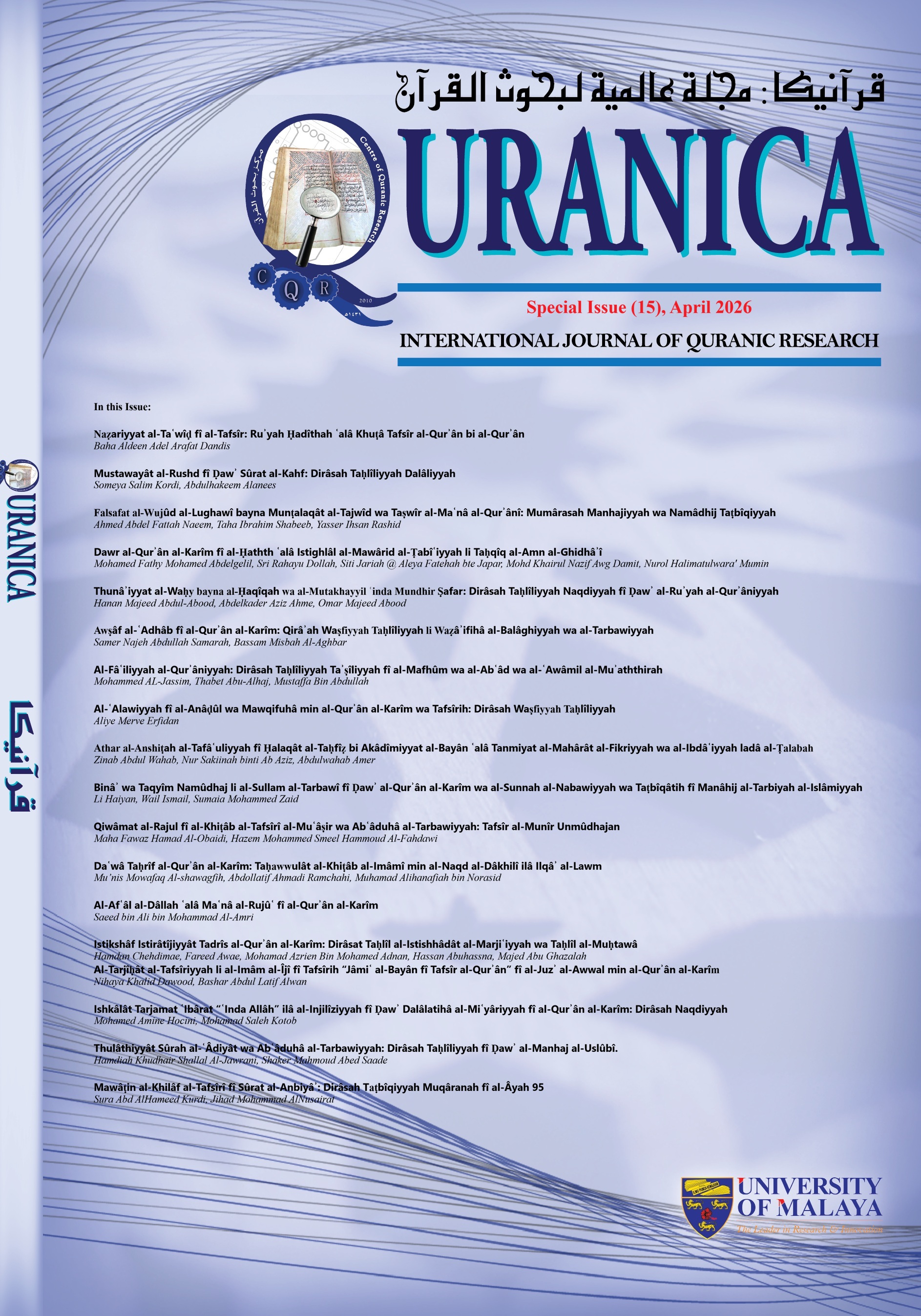
Daʿwā Taḥrīf al-Qurʾān al-Karīm: Taḥawwulāt al-Khiṭāb al-Imāmī min al-Naqd al-Dākhilī ilā Ilqāʾ al-Lawm
DOI:
https://doi.org/10.22452/quranica.vol18no1.12Keywords:
Qur’anic Distortion, Imamiyya, Akhbari Narrations, Shi‘i Studies, Comparative Critical Analysis.Abstract
This study examines the development of Imami discourse on the claim of Qur’anic distortion, beginning with early scholars such as al-Ḥurr al-ʿĀmilī, al-Majlisī, and al-Ṭabarsī, whose approaches to argumentation ranged from internal textual criticism and isnād analysis to balancing the Qur’an with transmitted reports, alongside invoking historical evidence for its preservation and compilation. These scholars showed a clear awareness of the challenges posed by the distortion claim and sought to affirm the central authority of the Qur’an within the Imami tradition, though they differed in how boldly they critiqued the relevant narrations—al-Ḥurr tending toward caution, while al-Ṭabarsī was more explicit. In contrast, some later scholars appear to have reduced their reliance on internal critique, instead attributing the issue to external factors such as Sunni discourse, the social conditions of the Shiʿa, or by drawing comparisons between distortion and the concept of abrogation in Sunni thought; this shift manifested in various ways, including assigning responsibility to Sunni narratives, tracing certain reports back to Sunni sources, offering sociological explanations, or reframing the discussion in comparative terms. Overall, the findings point to a gradual evolution in methods of critique among early scholars and a diversification in patterns of attribution among later ones, while underscoring the persistent concern across both phases with upholding the authority of the Qur’an and maintaining a clear relationship between the Qur’anic text and Imami narrations.
Downloads
Published
Issue
Section
License
Disclaimer
QURANICA makes every effort to ensure the accuracy of all its contents. However, opinions, discussions, views and recommendations are expressed in this journal do not necessarily reflect the official policy of QURANICA or views of its editors or publishers. Therefore, QURANICA and its publishers will not be liable for any controversy may be arisen. The journal reserves the right, at its sole discretion, to change its terms and conditions of publications.
Copyright
It is a condition of publication that manuscript submitted to the journal have not been published, accepted for publication, nor simultaneously submitted for publication elsewhere. By submitting a manuscript, the author(s) agrees that copyright for the article is transferred to the publisher, if and when the manuscript is accepted for publication.