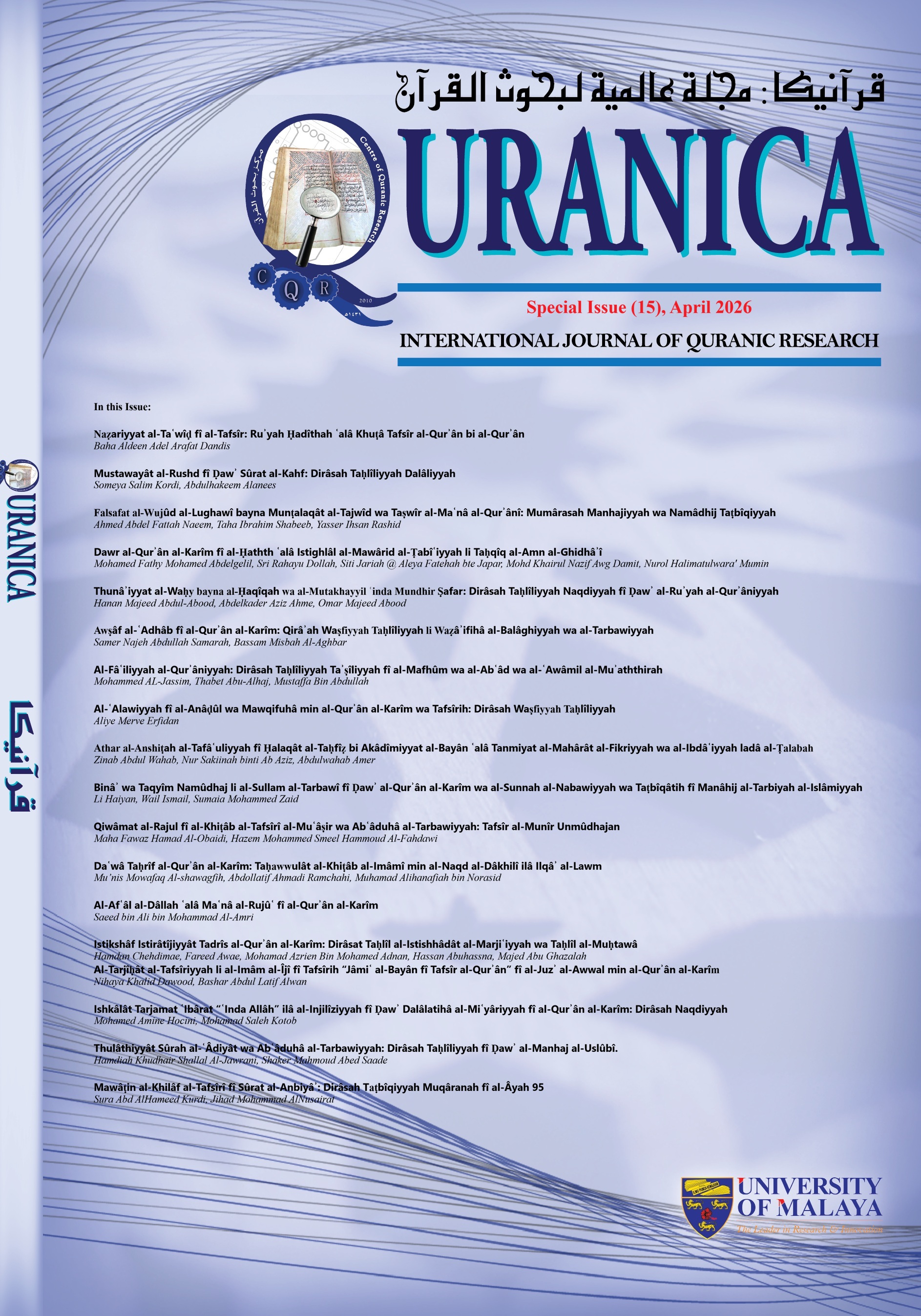
Al-ʿAlawiyyah fī al-Anāḍūl wa Mawqifuhā min al-Qurʾān al-Karīm wa Tafsīrih: Dirāsah Waṣfiyyah Taḥlīliyyah
DOI:
https://doi.org/10.22452/quranica.vol18no1.8Keywords:
Alawism, Anatolia, Quran, Interpretation, Sects.Abstract
This research elucidates the concept and history of Anatolian Alevism, examining its core tenets, practices, and stance on the Holy Quran and its interpretation through specific models. Utilizing a descriptive-analytical approach, the study investigates Alevism’s historical dimensions and doctrinal-practical shifts within foundational and contemporary contexts, while clarifying the socio-political conditions of its emergence. Furthermore, it explores the doctrinal content of Alevism and deduces its position on the Quran, culminating in an analytical reading of Haji Bektash Veli’s interpretation of Surah Al-Fatiha to clarify his exegetical tendencies and hermeneutic foundations.The study asserts that Alevism is a syncretic faith exhibiting Shamanic, Sufi, Shiite, and Hurufi influences. It concludes that while the Quran is deeply revered, the relationship remains superficial; no weight is given to the necessity of its understanding or interpretation. Finally, the research finds that Haji Bektash Veli’s exegesis aims to instruct the masses in Islamic lessons through narratives and symbols, manifesting clear Shiite influence, an Alevi tendency, and an allusive Sufi (ishari) orientation.
Downloads
Published
Issue
Section
License
Disclaimer
QURANICA makes every effort to ensure the accuracy of all its contents. However, opinions, discussions, views and recommendations are expressed in this journal do not necessarily reflect the official policy of QURANICA or views of its editors or publishers. Therefore, QURANICA and its publishers will not be liable for any controversy may be arisen. The journal reserves the right, at its sole discretion, to change its terms and conditions of publications.
Copyright
It is a condition of publication that manuscript submitted to the journal have not been published, accepted for publication, nor simultaneously submitted for publication elsewhere. By submitting a manuscript, the author(s) agrees that copyright for the article is transferred to the publisher, if and when the manuscript is accepted for publication.