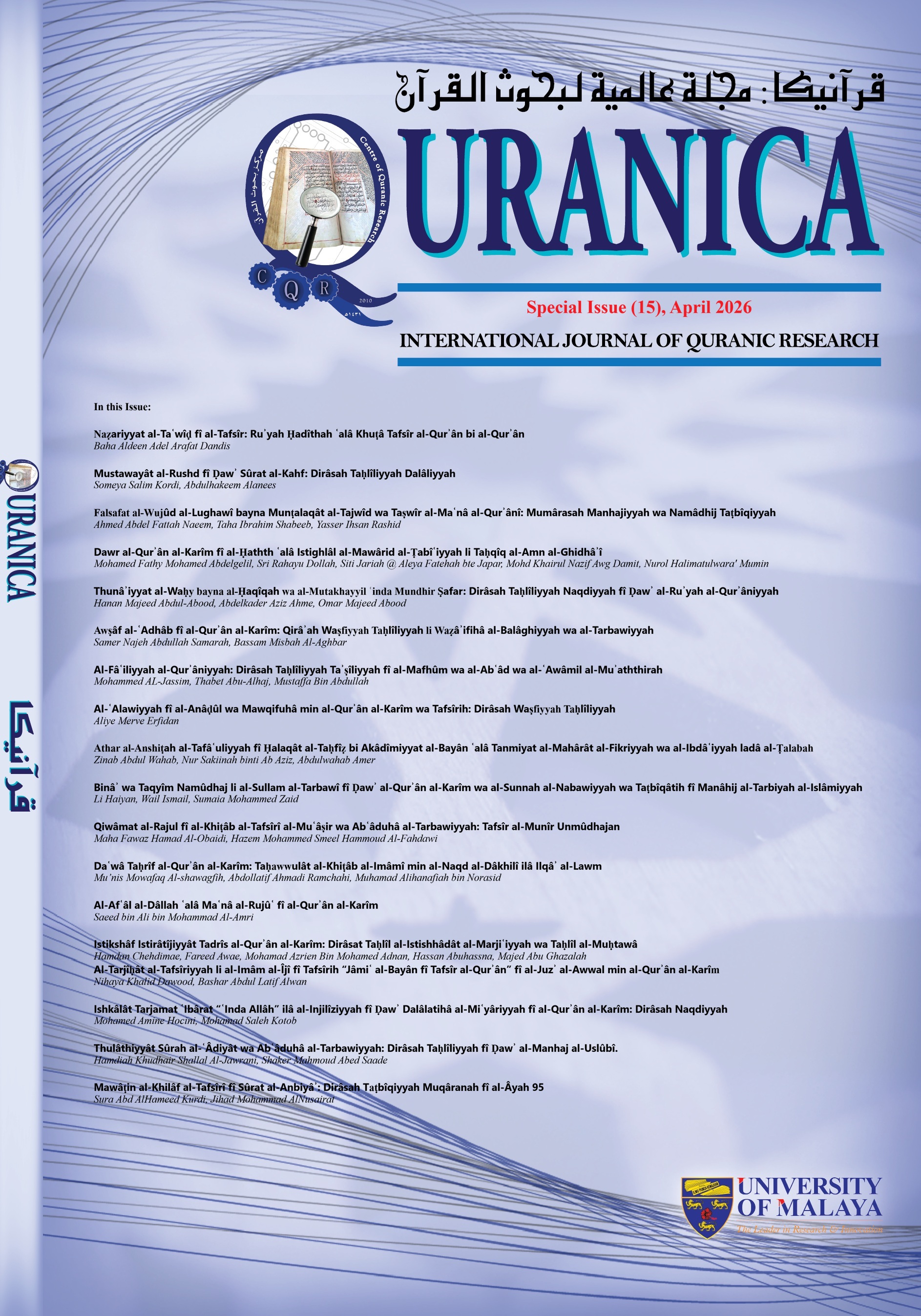
Thunāʾiyyat al-Waḥy bayna al-Ḥaqīqah wa al-Mutakhayyil ʿinda Mundhir Ṣafar: Dirāsah Taḥlīliyyah Naqdiyyah fī Ḍawʾ al-Ruʾyah al-Qurʾāniyyah
DOI:
https://doi.org/10.22452/quranica.vol18no1.5Keywords:
Revelation, Mundhir Safar, The Duality of Truth and Falsehood, Historical Method, Critical Analysis.Abstract
This study falls within the context of contemporary debates on the authenticity of the Qur’anic text and the nature of revelation, in which critical readings have emerged that seek to reconstruct the concept of “revelation” from within the textual corpus. Mundhir Safar's project is considered an approach that raises profound problems by positing a lack of correspondence between the “divine origin” and the “earthly version,” thereby calling for a critical examination of this duality and its implications for the text's sanctity and stability. The study aims to analyze and deconstruct Mundhir Safar’s interpretive vision regarding the nature of revelation, and to examine how he employs textual phenomena to demonstrate the historical process of the text. It also seeks to reveal the methodological tension in the separation of “truth” and “falsehood” within the concept of revelation, based on the criterion of textual clarity and ambiguity. The study adopts a critical analytical approach, employing contextual analysis tools to trace the interpretive trajectory of Safar’s project. It also utilizes qualitative content analysis of the key concepts proposed in the project and compares them with the civilizational and cultural extensions of the ancient Near East. The study concludes that Mundhir Safar’s project is based on a gradual shift from acknowledging a transcendent origin of revelation to formulating it within a purely human and historical framework, transforming revelation from an “absolute truth” into a “cultural phenomenon” with ancient Eastern roots. The findings also reveal that the criterion of “truth and falsehood” proposed by Safar is linked to mental representations of clarity, which has led to stripping the Qur’anic text of its attribute of stability and transforming it into the product of a changing historical process. The study concludes that this approach, despite its claim of originating from within the text, ultimately leads to the “relativization of revelation” and undermines its divine authority, opening the way to interpreting the Qur’anic text as a human text subject to the tools of historical criticism.
Downloads
Published
Issue
Section
License
Disclaimer
QURANICA makes every effort to ensure the accuracy of all its contents. However, opinions, discussions, views and recommendations are expressed in this journal do not necessarily reflect the official policy of QURANICA or views of its editors or publishers. Therefore, QURANICA and its publishers will not be liable for any controversy may be arisen. The journal reserves the right, at its sole discretion, to change its terms and conditions of publications.
Copyright
It is a condition of publication that manuscript submitted to the journal have not been published, accepted for publication, nor simultaneously submitted for publication elsewhere. By submitting a manuscript, the author(s) agrees that copyright for the article is transferred to the publisher, if and when the manuscript is accepted for publication.