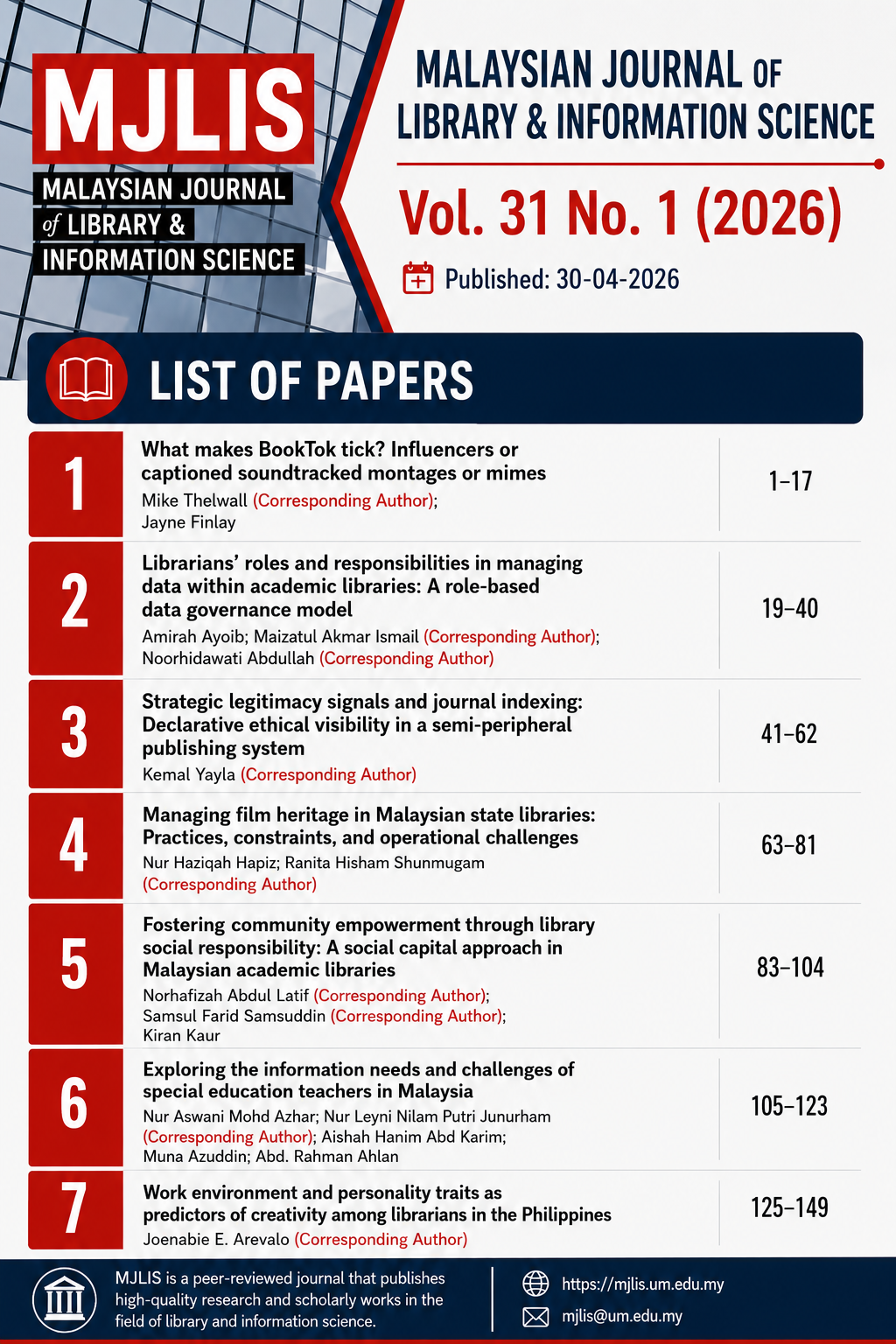
Exploring the information needs and challenges of special education teachers in Malaysia
DOI:
https://doi.org/10.22452/mjlis.vol31no1.6Keywords:
Information needs, Information-seeking behaviour, Special education teachers, Special needs school, MalaysiaAbstract
This study examines the information needs and challenges faced by special education teachers in Malaysia, focusing on how these educators identify, access, and use information to support teaching and learning in the classroom. Despite the increasing number of registered special needs children in Malaysia, the Malaysian government remains committed to advancing inclusive education and producing well-skilled special education teachers, particularly regarding teachers' information practices. Limited research has investigated the information practices of special education teachers, resulting in a gap in instructional support, resource development, and professional guidance. Using a qualitative design, in-depth semi-structured interviews were conducted with special education teachers from both urban and rural schools in various Malaysian states. This study was guided by three research questions: i) What are the information needs of special education teachers in Malaysia? ii) What information-seeking strategies and sources do special education teachers use to support their teaching and learning? iii) What challenges do special education teachers encounter in seeking and accessing information? The findings indicate that special education teachers primarily require information on teaching strategies, student behaviour, classroom management, and assessment tools. Their information-seeking strategies mainly rely on digital platforms, peer networks, official documents, and informal sharing communities. The most common barriers that hinder effective information use are inconsistent internet access, limited literacy training, and a lack of special education resources. This study emphasises the need for literacy training and information services for special education teachers in Malaysia and supports strategies for special needs school library support.
References
Abdul Ghani, N. B., Mohamad, Z. A., & Abu Bakar, C. W. T. C. W. (2013). Teachers’ Challenges in Educating Special Children in Special Classes of Three Selected Primary Schools, Kuala Terengganu, Terengganu, Malaysia. Advances in Natural and Applied Sciences, 7(3): 284-291.
Ahmed, M. B., Wan Mokhtar, W. N. H., & Baharuddin, M. F. (2025). Information-seeking behaviour and the use of electronic information resources among undergraduate students: A systematic literature review. Journal of Information and Knowledge Management, 15(SI2), 311–329. https://doi.org/10.24191/jikm.v15iSI2.8253.
Augustaitis, L., Merrill, L. A., Gamarel, K. E., & Haimson, O. L. (2021). Online transgender health information seeking: Facilitators, barriers, and future directions. In Proceedings of the 2021 CHI Conference on Human Factors in Computing Systems, 1-14. Association for Computing Machinery. https://doi.org/10.1145/3411764.3445091
Awang, S. R. (2016). Understanding the information-seeking behaviour of special education teachers in Singapore. Singapore Journal of Library and Information Management, 45, 1–15.
Beiriger, A., & Jackson, R. M. (2007). An assessment of the information needs of transgender communities in and, Oregon. Public Library Quarterly, 26(1–2), 45–60. https://doi.org/10.1300/J118v26n01_03.
Braun, V., & Clarke, V. (2021). To saturate or not to saturate? Questioning data saturation as a useful concept for thematic analysis and sample-size rationales. Qualitative Research in Sport, Exercise and Health, 13, 201–216, https://doi.org/10.1080/2159676X.2019.1704846.
Buku data pendidikan khas.(2025). https://www.moe.gov.my/pendidikan/pendidikan-khas.
Case, D. O. (2012). Looking for information: A survey of research on information seeking, needs, and behavior (3rd ed.). Bingley, United Kingdom: Emerald Group.
Case, D.O., & Given, O.L. (2016). What’s the use? Measuring the frequency of studies of information outcomes. Journal of the Association for Information Science & Technology, 67(3),649-661.
Chen, S., Mohamed Salleh, S., & Mohamad Salleh, M. A. (2025). Media and information Literacy among pre-service teachers: A systematic review of key trends and gaps (2013–2024). International Journal of Information Management Data Insights, 5(2), 100348. https://doi.org/10.1016/j.jjimei.2025.100348.
Chow, W. S. E., de Bruin, K., & Sharma, U. (2023). A scoping review of perceived support needs of teachers for implementing inclusive education. International Journal of Inclusive Education, 28(1), 1–20. https://doi.org/10.1080/13603116.2023.2244956.
Dahlqvist, C. (2021). Information seeking behaviours of teacher students: A systematic review of quantitative methods literature. Education for Information, 37(3), 287–313, https://doi.org/10.3233/EFI-200400.
Erlianti, G., Zuve, F. O., & Nabila, J. (2022). Patterns of information seeking behaviour from Leckie’s perspective in the new normal era. In Proceedings of the 5th International Conference on Language, Literature, and Education (ICLLE-5 2022) (pp. 426–436). Atlantis Press. https://doi.org/10.2991/978-2-494069-85-5_46.
Forbis, S., Rammel, J., Huffman, B., and Taylor, R. (2006). Barriers to care of inner‐city Children with asthma: school nurse perspective. Journal of School Health. 76(6), 205-207.
Gunasekera, C., & Balasubramani, R. (2021). Modelling Information Seeking Behaviour of School Teachers in Sri Lanka. Library Philosophy and Practice, 0_1-24.
Gunasekera, C., & Balasubramani, R. (2021). Modelling of information seeking behaviour of school teachers in Sri Lanka. Library Philosophy and Practice, 2021, Article 5244.
https://digitalcommons.unl.edu/libphilprac/5244/.
Hanif, S., & Warraich, N. F. (2023). Information sharing practices of Pakistani youth: A mixed-method study in an everyday context. Journal of Development and Social Sciences, 4(4), 753–761. https://doi.org/10.47205/jdss.2023(4-IV)67.
Hennink, M., & Kaiser, B. N. (2022). Sample sizes for saturation in qualitative research: A systematic review of empirical tests. Social Science & Medicine, 292, 114523. https://doi.org/10.1016/j.socscimed.2021.114523.
Ismail, N. A., Arumugam, N., & Li, T. T. (2023). Legal framework on special education for children with disabilities: Position in Malaysia and China. Current Legal Issues, 5, 70–87. https://ejournal.ukm.my/cli/article/view/89367.
Jayasooria, D.& Ooi, G. (1994). Disabled people’s movement in Malaysia. Disability and Society, 9(1),7-100.
Julien, H., Gross, M., & Latham, D. (2018). Survey of information literacy instruction practices. College & Research Libraries, 79(2), 179–198. https://doi.org/10.5860/crl.79.2.179.
Kheng, M., & Rusli, N. A. (2025). Teacher Training Programs: The Perspectives of Special Educational Needs (SEN) Teachers. International Journal of Instruction, 18(4), 335–352. https://doi.org/10.29333/iji.2025.18419a.
Kiili, C., Coiro, J., & Leu, D. J. (2021). Understanding and evaluating online information in educational contexts. Reading Research Quarterly, 56(1), 55–69. https://doi.org/10.1002/rrq.295.
Laari L (2025). Qualitative data saturation in health sciences research. Nurse Researcher. doi: 10.7748/nr. 2025.e1948.
Laloo, B., & Buhril, J. L. (2013). Information needs and information-seeking behavior of teachers of special education in Shillong, India. Journal of the American Academy of Special Education Professionals, 8(3), 48–69. https://doi.org/10.64546/jaasep.219.
Lee, L. W., & Low, H. M. (2014). The evolution of special education in Malaysia. British Journal of Special Education, 41(1), 42–58. https://doi.org/10.1111/1467-8578.12048.
Leckie, G. J., Pettigrew, K. E., & Sylvain, C. (1996). Modeling the information-seeking of professionals: A general model derived from research on engineers, health care professionals, and lawyers. The Library Quarterly, 66(2), 161-193. https://doi.org/10.1086/602864
Limberg, L., & Sundin, O. (2006). Teaching information seeking: Relating information literacy education to theories of information behaviour. Information Research, 12(1), Paper 280. https://informationr.net/ir/12-1/paper280.html.
Lytan, B., & Tariang, B. L. (2017). Information needs and seeking behaviour of the rainbow community: A case study of transgender individuals in Shillong. In S. K. Singh et al. (Eds.), Proceedings of the 1st International Conference on Transforming Library 2017 (pp. 360–373). MRB Publishers. https://doi.org/10.2991/978-2-494069-85-5_46.
Malterud, K., Siersma, V. D., & Guassora, A. D. (2016). Sample size in qualitative interview studies: Guided by information power. Qualitative Health Research, 26(13), 1753–1760. https://doi.org/10.1177/1049732315617444.
Montenegro-Rueda, M., Fernández-Cerero, J., Fernández-Batanero, J. M., & López-Meneses, E. (2023). Impact of the implementation of ChatGPT in education: A systematic review. Computers, 12(8), 153. https://doi.org/10.3390/computers12080153.
Nelson C. B., Melissa, A. S., & Kathleen, L. L. (2014). Special Education Teacher Burnout: A Synthesis of Research from 1979 to 2013. Education and Treatment of Children, 37(4), November 2014: 681-711.
Novian, R. M. (2024). Teachers’ information-seeking on accomplishments of academic tasks: A systematic review. Record and Library Journal, 10(2), 413–423. https://doi.org/10.20473/rlj.V10-I2.2024.413-423.
Novian, R. M., Dissamana, S., & Klungthanaboon, W. (2025). Investigation of information-seeking behavior of secondary school English teachers for preparing a lesson plan.
Journal of Information and Knowledge Management, 15(SI2), 23–41.
https://journal.uitm.edu.my/ojs/index.php/JIKM/article/download/7208/4375/30625.
Nur Emylia Nadia, N. A., & Jamayah, S. (2024). Psychological wellbeing of special education teachers with Down syndrome students. Journal of Cognitive Sciences and Human Development, 10(2), 51–72.https://doi.org/10.33736/jcshd.7484.2024.
OECD. (2024). Education at a glance 2024: OECD indicators. OECD Publishing. https://www.oecd.org.
Peciuliauskienė, P., Tamoliūnė, G., & Trepule, E. (2022). Exploring the roles of information search and information evaluation literacy and pre-service teachers’ ICT self-efficacy in teaching. International Journal of Educational Technology in Higher Education, 19, Article 33. https://doi.org/10.1186/s41239-022-00333-5.
Persons with Disabilities Act 2008. (2008). https://www.malaysia.gov.my/portal/content/30739.
Salji, M. R. (2015). Information-seeking behavior of academicians at Malaysia Institute of Integrative Media. Journal of Information and Knowledge Management (JIKM), 5(1), 61–70.
Shanmugam, A. (1999). Information-seeking behaviour of trainee teachers in selected teacher training colleges in Malaysia. Malaysian Journal of Library & Information Science, 4(1), 1–26.
Shahzad, K., Hashmi, F. S., Akhtar, M. N., Batool, S., & Aslam, M. W. (2025). Information-seeking behaviour of special education teachers in Pakistan. International Journal of Psychology and Special Education Research, 5(1), 23–35.
Shehryar, M., Khan, G., Jan, S. U., & Akram, S. (2021). Information Needs and Seeking Behavior of School Teachers in Khyber Pakhtunkhwa, Pakistan. Library Philosophy and Practice (e-journal), 5442.
Siti Nurul Maryam, & Kaur, K. (2024). Information needs of a vulnerable community: The case of visually impaired first-time mothers in Malaysia. Malaysian Journal of Library and Information Science, 29(1), 1–28. https://doi.org/10.22452/mjlis.vol29no1.1.
Taylor,R.S.(1968). Question negotiation and information seeking in libraries. College & Research Libraries,29(3),178-194.
Trixa, J., & Kaspar, K. (2024). Information literacy in the digital age: Information sources, evaluation strategies, and perceived teaching competences of pre-service teachers. Frontiers in Psychology, 15, 1336436. https://doi.org/10.3389/fpsyg.2024.1336436.
Yusup, Pawit M. (1995). Pedoman Praktis Mencari Informasi. Bandung: Remaja Rosdakary.
Wilson, T. D. (1997). Information behaviour: An interdisciplinary perspective. Information Processing & Management, 33(4), 551–572. https://doi.org/10.1016/S0306-4573(97)00028-9.
Downloads
Published
Issue
Section
License
It is a condition of publication that manuscripts submitted to the journal have not been published, accepted for publication, nor simultaneously submitted for publication elsewhere. By submitting a manuscript, the author(s) agree that copyright for the article is transferred to the publisher, if and when the manuscript is accepted for publication.