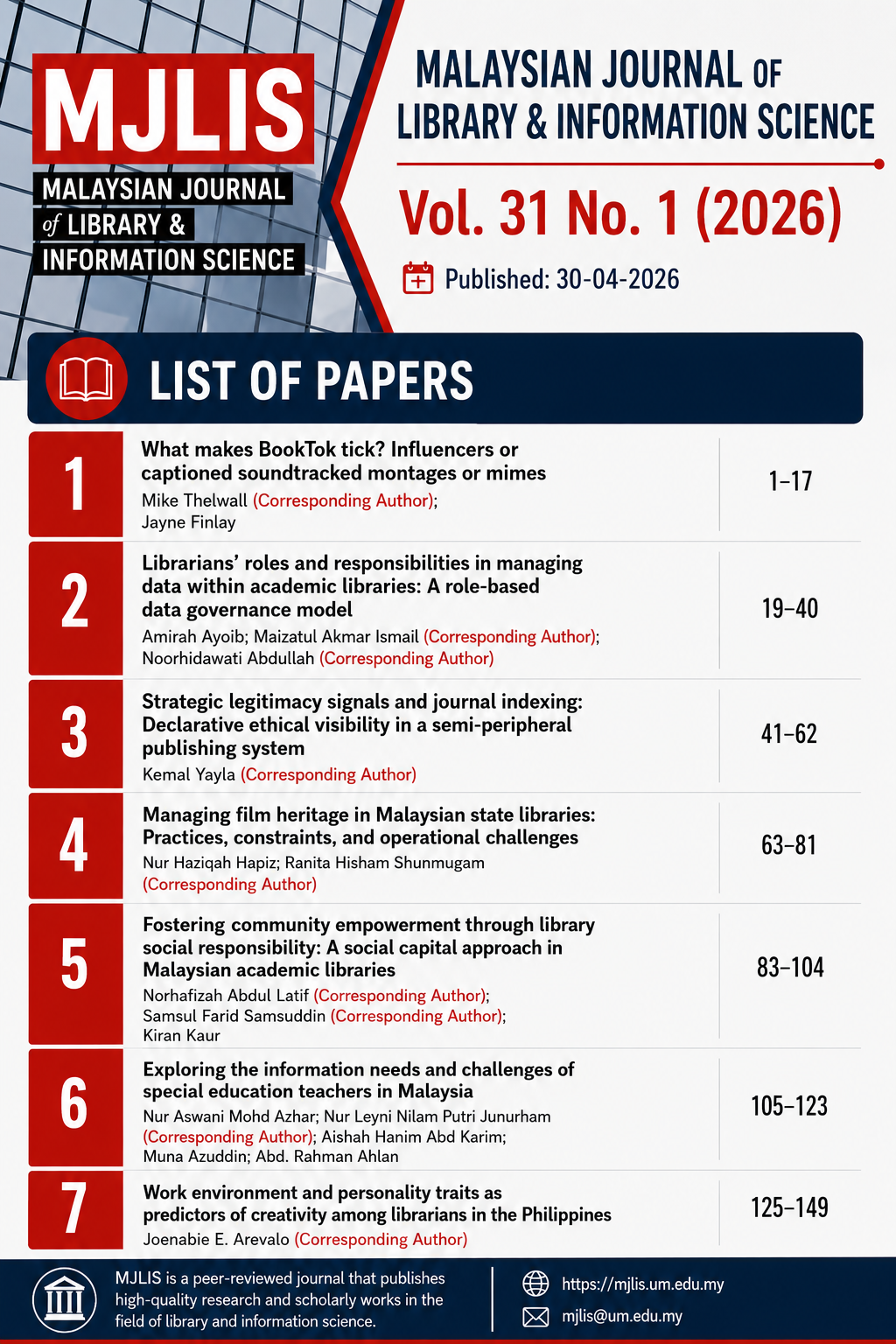
Managing film heritage in Malaysian state libraries: Practices, constraints, and operational challenges
DOI:
https://doi.org/10.22452/mjlis.vol31no1.4Keywords:
Audiovisual preservation, Metadata standards, Library digitisation, Cultural heritage access, User engagement, Southeast Asian librariesAbstract
Audiovisual collections in Malaysian state libraries help preserve national and regional memory but are highly vulnerable due to fragile media, obsolete playback technologies, and limited digital infrastructure. Film collections in these libraries face increasing threats from fragile media, obsolete playback technologies, and limited digital infrastructure. This study examines current management practices, access conditions, and operational challenges in Malaysian state libraries, and develops an empirically grounded framework to support preservation and access. A qualitative approach was employed, involving interviews with fifteen participants from five Malaysian state libraries representing different geographical regions of Malaysia. The findings reveal four key issues: inconsistent and limited metadata practices; reliance on obsolete playback equipment for VHS, VCD, and DVD formats; declining use and low public awareness; and copyright and resource constraints that hinder digitisation efforts. Despite these challenges, participants expressed strong support for structured Digital Asset Management (DAM) approaches, particularly for standardising metadata, strengthening preservation planning, and enabling controlled digital access. Based on these findings, the study proposes a resource-sensitive DAM framework integrating OAIS-aligned workflow logic, audiovisual metadata standards (PBCore and PREMIS), phased digitisation, and multilingual access considerations. The framework is tailored to Malaysian public library realities and may be relevant to similar resource-constrained public library contexts in Southeast Asia.
References
Alzahrani, A. I., Mahmud, I., Ramayah, T., Alfarraj, O., & Alalwan, N. (2019). Modelling digital library success using the DeLone and McLean information system success model. Journal of Librarianship and Information Science, 51(2), 291–306. https://doi.org/10.1177/0961000617726123.
Baca, M. (Ed.). (2016). Introduction to metadata (3rd ed.). Getty Publications. https://www.getty.edu/publications/intrometadata/.
Braun, V., & Clarke, V. (2006). Using thematic analysis in psychology. Qualitative Research in Psychology, 3(2), 77–101. https://doi.org/10.1191/1478088706qp063oa.
Consultative Committee for Space Data Systems. (2024). Reference model for an Open Archival Information System (OAIS) (Magenta Book, CCSDS 650.0-M-3). https://ccsds.org/Pubs/650x0m3.pdf.
Corrado, E. M., & Moulaison-Sandy, H. (2017). Digital preservation for libraries, archives, and museums (2nd ed.). Rowman & Littlefield.
Cox, A. M., Kennan, M. A., Lyon, L., & Pinfield, S. (2017). Developments in research data management in academic libraries: Towards an understanding of research data service maturity. Journal of the Association for Information Science and Technology, 68(9), 2182–2200. https://doi.org/10.1002/asi.23781.
Day, M., Macdonald, A., Kimura, A., & Peacock, M. (2014). Identifying digital preservation requirements: Digital preservation strategy and collection profiling at the British Library. In Proceedings of the 11th International Conference on Preservation of Digital Objects (iPRES 2014). https://www.digipres.org/publications/ipres/ipres-2014/papers/identifying-digital-preservation-requirements-digital-preservati/.
Edmondson, R. (2016). Audiovisual archiving: Philosophy and principles (3rd ed.). UNESCO. https://unesdoc.unesco.org/ark:/48223/pf0000243973.locale=en.
International Association of Sound and Audiovisual Archives. (2019). IASA-TC 06 guidelines for the preservation of video recordings. https://www.iasa-web.org/tc06/guidelines-preservation-video-recordings.
International Federation of Film Archives. (2016). The FIAF moving image preservation & restoration manual. https://www.fiafnet.org/images/tinyUpload/E-Resources/Commission-And-PIP-Resources/CDC-resources/20160920_Fiaf_Manual-WEB.pdf
International Federation of Library Associations and Institutions. (2009). Multicultural communities: Guidelines for library services. (3rd ed.). https://repository.ifla.org/items/792359f1-e887-46e5-8022-3bf68fe56073
Kwiecien, K., Chansanam, W., & Tuamsuk, K. (2025). Digital cultural heritage in Southeast Asia: Knowledge structures and resources in GLAM institutions. Informatics, 12(3), 96. https://doi.org/10.3390/informatics12030096.
Masenya, T. M., & Ngulube, P. (2020). Factors that influence digital preservation sustainability in academic libraries in South Africa. South African Journal of Libraries and Information Science, 86(1), 52–63. https://doi.org/10.7553/86-1-1860.
McCain, E., Neil, M., Van Malssen, K., Carner, D., Reilly, B., Willette, K., Schiefer, S., Askins, J., & Buchanan, S. (2021). Endangered but not too late: The state of digital news preservation. University of Missouri. https://hdl.handle.net/10355/80931.
National Library Board Singapore. (2024). Digital Repository Singapore. https://eresources.nlb.gov.sg/.
National Library of Malaysia. (2020). Annual report 2020. https://www.pnm.gov.my/index.php/pages/view/306.
New York Public Library. (2019). NYPL Digital Collections: Technical documentation. https://digitalcollections.nypl.org/.
Ngulube, P. (2003). Preservation and access to public records and archives in South Africa [Doctoral dissertation, University of Natal). https://researchspace.ukzn.ac.za/items/c9ca2d16-40b8-460d-a3b9-d04300d0e7ed.
Nor Hasni Che Hassan, Wan Satirah Wan Mohd Saman, & Norshila Shaifuddin. (2023). Balancing sustainability factors in the implementation of digital libraries for Malay manuscripts: A framework proposal. Journal of Information and Knowledge Management, 2(SI), 242–263. https://ir.uitm.edu.my/id/eprint/87380/1/87380.pdf
Owens, T. (2018). The theory and craft of digital preservation. Johns Hopkins University Press. https://muse.jhu.edu/book/62324.
Pacheco, A., da Silva, C. G., & de Freitas, M. C. V. (2023). A metadata model for authenticity in digital archival descriptions. Archival Science, 23, 629–673. https://doi.org/10.1007/s10502-023-09422-w.
PREMIS Editorial Committee. (2015). PREMIS data dictionary for preservation metadata (Version 3.0). http://www.loc.gov/standards/premis/.
United Nations Educational, Scientific and Cultural Organization. (2005). Memory of the World: General guidelines to safeguard documentary heritage. https://unesdoc.unesco.org/ark:/48223/pf0000125637
United Nations Educational, Scientific and Cultural Organization. (2018). Survey on audiovisual heritage preservation in developing countries. https://unesdoc.unesco.org/ark:/48223/pf0000375976.
WGBH Educational Foundation. (2018). PBCore 2.1: Public broadcasting metadata dictionary. http://pbcore.org/.
Woo, W. H. (2002). Digital library of historical buildings: A Malaysian initiative. Library Review, 51(5), 246–251. https://doi.org/10.1108/00242530210438538.
Downloads
Published
Issue
Section
License
It is a condition of publication that manuscripts submitted to the journal have not been published, accepted for publication, nor simultaneously submitted for publication elsewhere. By submitting a manuscript, the author(s) agree that copyright for the article is transferred to the publisher, if and when the manuscript is accepted for publication.